Historical Medicine Research for Writers
Historical medicine research for writers starts with a date and a place. A character in a medieval English village, an eighteenth-century London household, and a late nineteenth-century hospital would meet different caregivers and hear different explanations for the same fever. Before germ theory gained acceptance, many European practitioners explained disease through bodily imbalance or unhealthy air. Those beliefs shaped treatment, but practice varied by region, wealth, and individual healer.
For a scene involving illness, surgery, childbirth, or bereavement, find out how people in that decade understood what was happening. Treatments that seem cruel now followed a logic drawn from ancient medical traditions. That logic affects what a healer says at the bedside and what a family expects them to do. Check who attended the patient, how they reached a diagnosis, which tools they had, and how the household prepared for a possible death.
For a broader research plan, start with how to research a historical novel. For stories centered on manorial estates or medieval villages, our guide to medieval daily life for fiction writers provides context on sanitation and diet.
A working timeline for the sickroom
Medieval Europe: Learned medicine drew on classical authorities and humoral theory, while households, midwives, religious institutions, and local practitioners supplied much daily care. A university physician in a city and a rural household did not have the same options.
Early modern Europe, roughly 1500 to 1750: Physicians, surgeons, apothecaries, and domestic healers worked in an overlapping medical market. Epidemics prompted quarantine and theories about corrupted air. A printed remedy tells you what someone recommended, not what every household used.
Late eighteenth and early nineteenth centuries: Inoculation and then vaccination changed smallpox prevention. Hospitals, anatomical study, and instruments acquired greater importance, while operations still carried severe pain and infection risk. Check the decade before putting a new practice into a character's hands.
Mid to late nineteenth century: Ether anaesthesia entered surgery in the 1840s. Hand disinfection in obstetrics and antiseptic surgery followed, with uneven uptake. A hospital in 1850 should not look like one in 1890. The Royal College of Surgeons' account of Lister's work is a useful starting point for those changes.
The four humors and pre-modern medical logic
The theory of the four humors underpinned Western medical practice from antiquity through the seventeenth century. It lingered in popular domestic thought well into the nineteenth century. The theory came from the teachings of Hippocrates and was codified by Galen of Pergamon in the second century. It held that the body contained four vital fluids:
- Blood: Associated with the element of air, warm and moist qualities, spring, and a sanguine temperament.
- Phlegm: Associated with the element of water, cold and moist qualities, winter, and a phlegmatic temperament.
- Yellow Bile (Choler): Associated with the element of fire, warm and dry qualities, summer, and a choleric temperament.
- Black Bile (Melancholy): Associated with the element of earth, cold and dry qualities, autumn, and a melancholic temperament.
Health (eukrasia) meant a balance among these fluids appropriate to the person's constitution, or complexion. Sickness (dyskrasia) arose when one humor corrupted, putrefied, or overwhelmed the others. Emotional distress, spoiled food, stagnant marsh mist, sudden chills, and celestial movements could all explain an imbalance. A diagnosis therefore considered the whole patient rather than an isolated organ.
This reasoning explains the use of depletion therapies at the bedside. If a fever made a patient hot and dry, the physician identified an excess of warm blood or yellow bile and tried to remove it. Options included venesection (opening a vein with a lancet), leeches, purgatives to induce violent diarrhea, and emetics to provoke vomiting. Caustic pastes blistered the skin to draw out what practitioners considered toxic fluids. A novelist may see only butchery in bloodletting; the practitioner saw the removal of a pint of blood as a calculated, urgent attempt to restore balance.
In Medicine & Society in Later Medieval England (1995, Carole Rawcliffe on Open Library), Carole Rawcliffe describes diagnosis that combined bodily observation with cosmology. Medieval physicians used a circular uroscopy wheel to assess urine, comparing color, sediment, cloudiness, and taste against twenty categories. They also cast astrological charts to choose the planetary hour for an incision. They believed that operating while the moon passed through a constellation ruling the affected body part could cause uncontrollable hemorrhage.
The hierarchy of healers: who treated whom
The doctor with a black leather bag who sets bones, delivers babies, diagnoses consumption, and compounds drugs is a familiar figure in fiction. Before assigning all those tasks to one character, check the divisions of medical work in your setting. Social rank, education, gender, and cost determined who treated whom.
University-trained physicians
The university-trained physician held the highest social rank. His education involved Greek, Latin, and classical philosophical texts rather than cadaver dissection. In England, fellows of the Royal College of Physicians worked mainly in major cities, treating the aristocracy, landed gentry, and wealthy merchants. A physician rarely touched the patient directly. He observed the complexion, smelled the urine, checked the pulse, and wrote a prescription in Latin for an apothecary to compound. Agricultural laborers and struggling artisans could not afford his fees.
Barber-surgeons
Surgeons ranked below physicians and often belonged to urban craft guilds alongside barbers, including the Company of Barber-Surgeons. Surgery was a manual trade, learned through apprenticeship rather than university lectures. Surgeons dressed wounds, lanced boils, set fractures, reduced dislocations, pulled teeth, and performed amputations. Their work with external ailments and physical injuries called for iron knives, saws, needles, and cauterizing irons. Over centuries, military conflicts in particular gave surgeons extensive anatomical experience. They separated from the barbers in the mid-eighteenth century and established independent surgical colleges.
Apothecaries
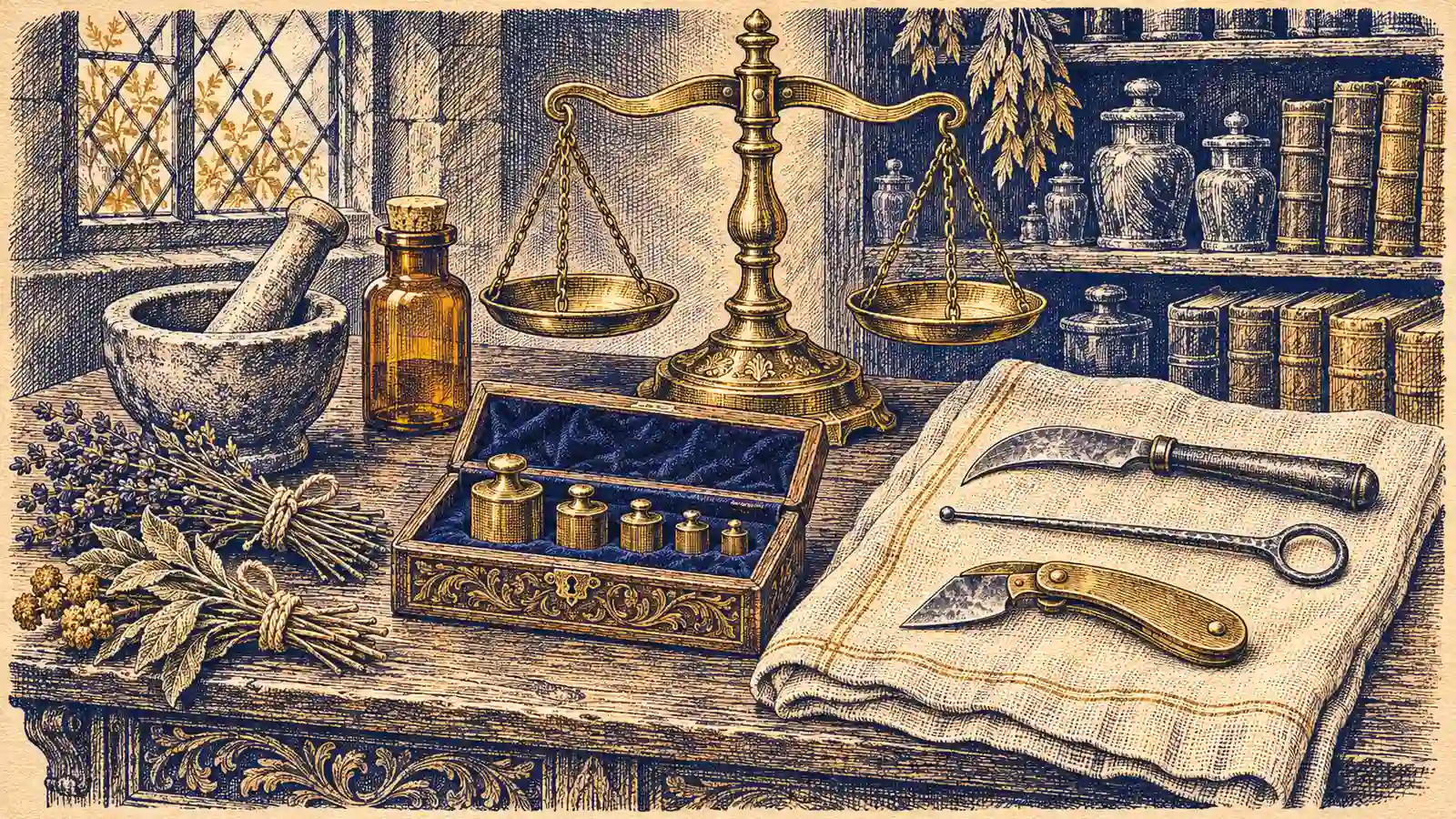
Apothecary shops stocked jars of dried botanicals, mineral salts, animal fats, and imported spices. Their formal job was to compound physicians' prescriptions, but urban middle- and working-class patients also went to them directly. A shopkeeper or master weaver with a persistent cough or colic could buy a cordial, draught, or plaster at the counter without paying a physician's fee. Apothecaries gradually became general medical practitioners.
Housewives and domestic healers
Much medical care took place inside the home, often managed by women. Surviving manuscript receipt books show some households recording culinary instructions and medical remedies. Domestic healers might grow sage, mint, rue, wormwood, feverfew, and chamomile. Rural communities also turned to local healers and bone-setters, whose practical knowledge coexisted alongside formal medicine.
In Medicine and Society in Early Modern Europe (1999, Mary Lindemann on Open Library), Mary Lindemann examines how these healers competed for patients. People moved between physicians, apothecaries, empirics, faith healers, and neighbors. They tried remedies and negotiated treatment according to what they could afford and whose reputation they trusted.
Surgery before anaesthesia and antisepsis
A surgical scene needs enough physical detail to convey the patient's ordeal without dwelling on horror for its own sake. Until the successful demonstration of ether in 1846 and chloroform in 1847, surgery was agonizing and a last resort.
Speed mattered to a pre-anaesthetic surgeon because it shortened the patient's ordeal. Robert Liston became famous for rapid amputations, though a precise time for a particular operation needs a specific source. Assistants might restrain the patient while the surgeon worked. A tourniquet could help restrict bleeding.
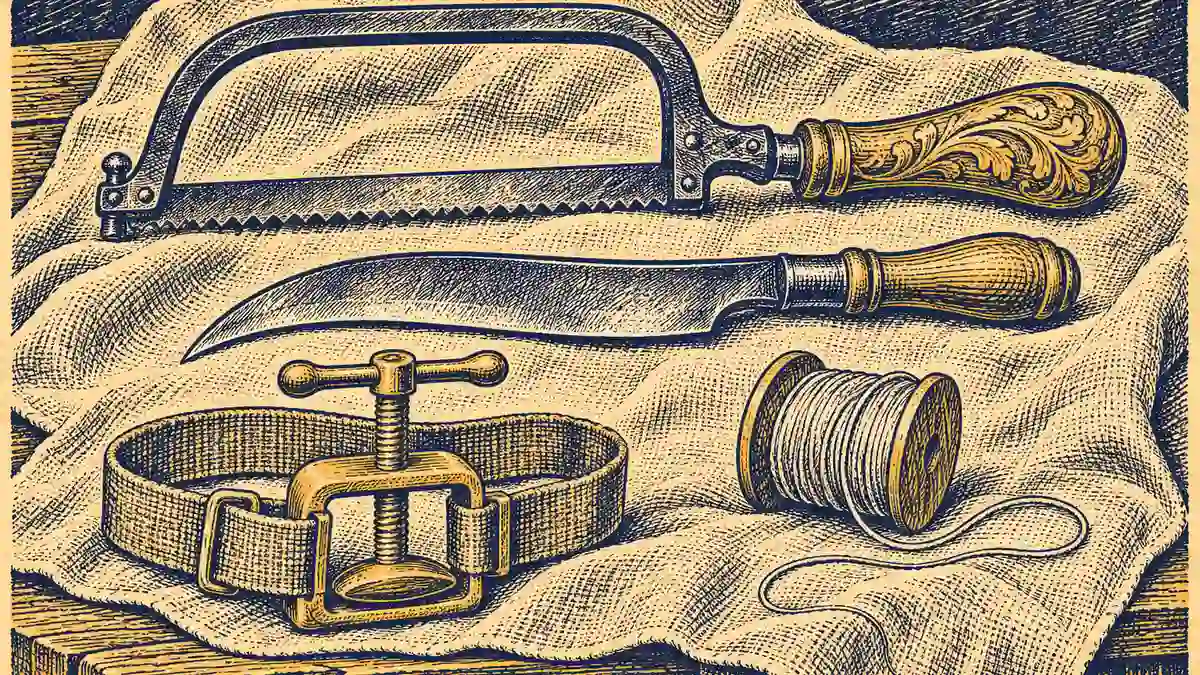
Surgeons used brandy, rum, or large doses of laudanum (tincture of opium) for pain relief. Heavy sedation could slow breathing or cause vomiting while the patient lay strapped flat. Patients often fainted from pain within moments of the first incision; surgeons welcomed that loss of consciousness.
The operating room also exposed patients to lethal infection. Surgeons wore old coats stiff with dried blood and pus from earlier operations, taking the stains as evidence of experience. Between patients, they wiped instruments on soiled cloths or aprons. A surgeon might hold silk ligature threads in his mouth while his hands worked inside the wound, then use those threads to tie off arteries.
Following surgery, some practitioners welcomed what they called "laudable pus," treating discharge as a sign of healing. A modern diagnosis cannot be read reliably from that description alone. Infection remained a grave danger, especially in crowded hospitals. Joseph Lister began applying antiseptic methods in the 1860s, and adoption took time. The Royal College of Surgeons' history of surgical clothing shows how operating practice changed.
In The Greatest Benefit to Mankind: A Medical History of Humanity (1997, Roy Porter on Open Library), Roy Porter follows the gradual, contested decline of classical humoral doctrine between the Enlightenment and the late nineteenth century. Hospital medicine, anatomical dissection, and pathology all contributed to that change.
For details on naval warfare, shipboard sick bays, and amputations performed in the cockpit during naval engagements, see our guide on age of sail research for writers.
Childbirth in the household
In medieval and early modern households, the "lying-in" was understood as a female domestic event. Childbirth was a dangerous natural trial, with rituals and spiritual preparations, rather than an illness that required a hospital.
When labor began, the mother went to the lying-in chamber. Shutters, heavy curtains, and cloth stuffed into drafty crevices kept out bad air and light. Attendants stoked the fire even in summer, believing that heat helped the body expand and loosened tight tissues.
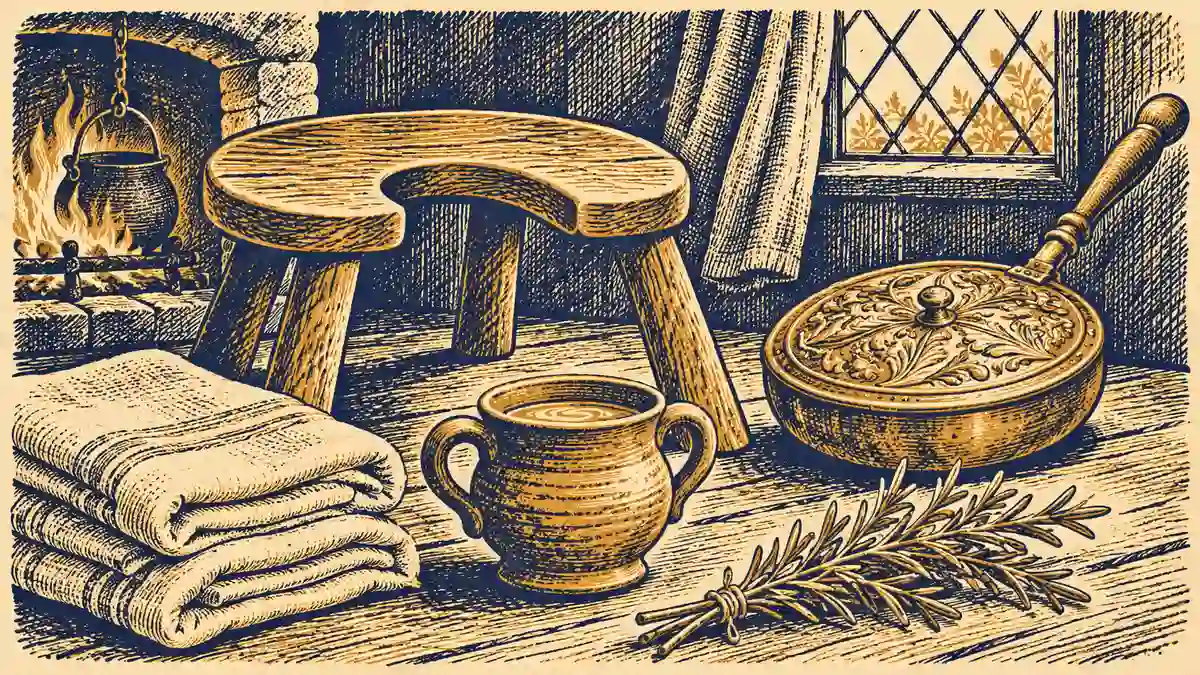
The chamber was staffed by women:
- The midwife: A respected, mature woman who had borne children herself. Midwives were licensed by ecclesiastical authorities, not medical boards. The church required midwives to take an oath promising not to use witchcraft, to discard caul tissues properly, and to administer emergency baptism if an infant seemed unlikely to survive.
- The "gossips": Female kin, neighbors, and friends invited to attend the birth. Derived from the Old English godsibb (a god-sibling or sponsor in baptism), the gossips provided physical support, rubbed the mother's back, held her upright on a birthing stool, and prepared nourishing caudles (warm ale or wine boiled with oatmeal, egg yolks, sugar, and spices).
Many births were attended chiefly by women, but arrangements varied by place, class, and period. In a difficult labor, a surgeon might be summoned. Obstetrical forceps became more widely used in the eighteenth century; a novelist should check the local practice before bringing them into a scene.
In the eighteenth century, wealthy households began employing the "man-midwife" (accoucheur), a controversial change. Male practitioners with the secret locking forceps popularized by the Chamberlen family replaced female midwives in fashionable urban households. Forceps saved lives in obstructed deliveries. But practitioners also carried infection on unwashed hands and instruments from fever wards into postpartum bedrooms, causing deadly outbreaks of puerperal fever (childbed fever).
In Death in Childbirth: An International Study of Maternal Care and Maternal Mortality 1800-1950 (1992, Irvine Loudon on Open Library), Irvine Loudon studies changes in maternal mortality across places and periods. At Vienna General Hospital in the 1840s, Ignaz Semmelweis found that disinfecting attendants' hands sharply reduced deaths from childbed fever, as the Science History Institute's account explains.
Epidemics, contagion, and death in the historical record
The constant threat of sudden death affected how people understood illness. For an epidemic scene, research what your characters believed was killing their neighbors and what they thought might protect them.
The dominance of miasma theory
Before microbes were identified, people attributed epidemic disease to miasma: poisonous vapor from rotting vegetation, stagnant bogs, cesspools, unburied corpses, and foul drains. They believed that breathing this air poisoned the blood and disturbed the vital spirits.
Attempts to prevent disease followed that explanation:
- Some seventeenth-century plague physicians wore protective gowns and beaked masks stuffed with aromatic substances. The costume belongs to a specific time and place, as Wellcome Collection's history of medical masks makes clear.
- Citizens carried pomanders (silver or orange balls studded with cloves) or walked through streets clutching handkerchiefs soaked in vinegar.
- Municipalities burned barrels of pitch, sulfur, and bonfires at crossroads to disperse stagnant vapors and purify the atmosphere.
- In hospitals and homes, vinegar was sprinkled on floors, and rooms were fumigated with tobacco smoke or burning rosemary.
For Georgian poverty, urban hazards, and social conditions, see our Regency Britain research guide.
The ritual of the good death
High mortality at every age made death a familiar, public part of household life. The "good death" (ars moriendi) required the dying person to remain conscious as long as possible. They were expected to make peace with God, forgive enemies, settle debts, bless the children weeping at the bedside, and speak pious final words.
After death, neighbors washed the body, wrapped it in a linen winding sheet, and kept vigil at a wake in the parlor before burial in the parish churchyard. The rhythm of the parish bell told the community that someone had died.
Worked edit example: revising an anachronistic sickbed scene
Consider the medical details in this eighteenth-century sickbed scene:
Before: Doctor Higgins took a sterile scalpel from his medical kit and placed a digital glass thermometer under Lord Danbury's tongue. "His fever is 103 degrees," the doctor announced, washing his hands thoroughly with carbolic soap in a basin of hot water. "A virulent bacterial infection has settled deep in his lungs. If we do not administer modern antibiotics immediately, septic shock will set in within forty-eight hours."
The passage has four anachronisms for an eighteenth-century setting: sterile instruments did not exist, numerical clinical thermometers were not routine bedside tools until late in the nineteenth century, handwashing with antiseptic soap postdated 1865, and bacteria, antibiotics, and septic shock were unknown concepts.
The period details change what the doctor notices and proposes:
After: Doctor Higgins wiped his lancet against the sleeve of his wool coat and placed two fingers upon Lord Danbury's fluttering wrist. "The pulse gallops and the skin burns like dry brick," the doctor announced, squinting at the cloudy amber sediment in the glass urinal beside the bed. "An excess of choler has overheated the blood and inflamed the pleura. We must draw twelve ounces of blood from the arm at once and apply a blistering plaster of Spanish fly to his chest to draw the noxious heat outward."
Pulse quality, dry heat, and sediment in the urine give the doctor grounds for a humoral diagnosis of overheated choler. His proposed treatments are venesection and counter-irritant blistering with cantharides (Spanish fly). Lord Danbury is still in danger; the medical explanation and proposed response belong to his period.
Research the treatment your scene needs
Work through these questions before deciding how an injury or illness will affect the plot:
- Fix the decade: Check whether your setting predates William Harvey's discovery of blood circulation (1628), precedes the introduction of Jenner's smallpox vaccination (1796), comes before surgical anaesthesia (1846), or predates the acceptance of germ theory and carbolic antisepsis (late 1860s to 1880s).
- Match the caregiver to the character's class: Do not default to a physician for an impoverished farm laborer or urban chimney sweep. Use a family member, an herbalist, an apothecary, or a local barber-surgeon.
- Check which drugs were available: Verify that the drug was in use. Opium and alcohol have been used since antiquity, and Peruvian bark (cinchona bark containing quinine) arrived in Europe in the 1630s for malaria. However, digitalis for heart conditions dates to William Withering's work in 1785, morphine was isolated in 1804, aspirin was synthesized in 1897, and penicillin did not reach clinical use until the 1940s.
- Work out the sickroom's details: Describe the heavy draperies, banked hearth fires, the smell of vinegar and tallow, the linen bandages washed in lye, and the porcelain or pewter spitting pots.
- Keep a reference file: Track period terminology, apothecary weights (grains, scruples, drachms, ounces), and clinical symptoms together. For ways to organize these files, see our guide on keeping research notes for novelists.
Common mistakes novelists make with historical illness
Check these details when reviewing an illness or injury scene:
- The instant knockout: Characters are routinely struck on the head with a pistol butt or club, knocked unconscious for three hours, and awake with nothing more than a slight headache. In pre-modern medicine, prolonged unconsciousness indicated severe traumatic brain injury, intracranial hemorrhage, or skull fracture, frequently leading to coma and death within days.
- The modern clean freak doctor: A doctor boils his tools, washes his hands obsessively before touching a patient, or demands fresh linens to avoid invisible germs. Check the date before giving him ideas that belong to the work of Louis Pasteur and Joseph Lister centuries later.
- Romanticized consumption: A rosy-cheeked heroine coughing discreetly into a lace handkerchief gives little sense of advanced tuberculosis (consumption). Its symptoms included violent coughing spasms, thick blood and foul phlegm, night sweats that drenched mattresses, chronic diarrhea, and skeletal emaciation.
- Instant death or instant recovery from stab wounds: The course of an abdominal wound depends on what was struck, the bleeding, contamination, and available care. A survivor might deteriorate from infection over days. Check the anatomy and wound before fixing a dramatic timetable.
- Assuming frequent loss meant less grief: Losing multiple children in infancy did not make parents callous or emotionally detached. Medieval and early modern private letters, diaries, and funeral poetry record devastating grief over the deaths of infants.
Primary archives, digitized casebooks, and reference books
These archives and books can help you check the details of a medical scene:
- Wellcome Collection: A medical history archive with freely accessible digital collections of early modern recipe books, medieval medical manuscripts, anatomical engravings, and surgical instruments.
- National Library of Medicine: The U.S. National Library of Medicine maintains extensive digital collections, including historical clinical treatises, public health broadsides, and historical photographic archives.
- Roy Porter, The Greatest Benefit to Mankind: A Medical History of Humanity (1997, Roy Porter on Open Library): A broad, readable history of Western medicine from antiquity to the twentieth century.
- Mary Lindemann, Medicine and Society in Early Modern Europe (1999, Mary Lindemann on Open Library): A study of how ordinary people dealt with healing, quackery, illness, and medical hierarchies between 1500 and 1800.
- Carole Rawcliffe, Medicine & Society in Later Medieval England (1995, Carole Rawcliffe on Open Library): A study of medieval hospitals, civic sanitation, humoral theory, and diagnostic practices.
- Irvine Loudon, Death in Childbirth: An International Study of Maternal Care and Maternal Mortality 1800-1950 (1992, Irvine Loudon on Open Library): A statistical and historical study of maternal mortality, midwifery, and obstetrical intervention across three centuries.
Frequently asked questions
When were surgical anaesthetics first introduced?
Surgical anaesthesia spread in the mid-1840s. Horace Wells tried nitrous oxide for dental work, William T. G. Morton demonstrated ether at Massachusetts General Hospital in October 1846, and James Young Simpson introduced chloroform in Edinburgh in 1847. Before its adoption, major operations generally took place without effective general anaesthesia; availability still depended on where and when the operation occurred.
How did pre-modern doctors diagnose diseases without lab tests?
Practitioners observed the patient and asked questions. They checked the pulse for speed, rhythm, hardness, and fullness, and examined the tongue's color and moisture. Skin, eyes, bodily odors, and stools also supplied clues. Specialized glassware and diagnostic charts helped them assess urine for clarity, sediment, and color.
Did medieval and early modern people have any effective painkillers?
They used opium in several preparations, including laudanum, as well as alcohol and infusions of willow bark. Willow bark contains salicin, a chemical precursor to aspirin. Ancient and medieval soporific draughts also used henbane and mandrake, but doses were difficult to control and could be fatal.
How did people treat chronic wound infections before antibiotics?
Practitioners cleaned wounds, removed damaged tissue, cauterized bleeding, and applied dressings such as honey, wine, or vinegar in some settings. A historical recipe is evidence of a proposed treatment, not proof that it worked or was used everywhere. Deep or contaminated wounds could become infected, but a character's outcome depended on the injury and care available.