
Age of Sail Research for Writers: A Practical Guide
DA505–522Library of Congress browsing range for Britain under George III, 1760–1820. Check your library’s catalog for each book’s call number.

Start Age of Sail research with the vessel your characters live aboard. An eighteenth-century warship was both an industrial community and a wooden fortress. Between 1700 and 1815, its layout, watch rotations, naval law, and food supplies shaped what people could do. Learn those constraints before filling a scene with nautical terms. Where can a character stand? Who is on duty, and whose orders must they obey? The answers give you something to build a scene around.
Naval fiction can go wrong in either direction. Sailors who use contemporary jargon and officers who treat everyone as equals make a manuscript read like a modern military thriller in fancy dress. Too many unexplained sea terms can leave readers unable to follow the action. Use the vocabulary your scene needs, and connect it to what a character can see, hear, or handle.
The anatomy of a warship: rates, decks, and physical constraints
Choose the class of vessel before placing your characters aboard. The Georgian Royal Navy rated its warships by the number of carriage guns mounted on their broadside decks.
The Royal Navy rating system
The Admiralty classified vessels from the first through sixth rates, alongside unrated smaller craft:
- First Rate: 100 or more guns arranged across three complete gun decks, carrying a crew of 850 to 875 men. Flagships such as HMS Victory were fleet admirals' floating headquarters.
- Second Rate: 90 to 98 guns on three decks, with roughly 750 men. They offered heavy firepower but were often top-heavy and difficult to handle in rough seas.
- Third Rate: 64 to 80 guns on two gun decks, crewed by 500 to 650 men. The 74-gun third rate combined firepower, speed, and seaworthiness and formed the backbone of the line of battle.
- Fourth Rate: 50 to 60 guns on two decks. By the late eighteenth century, they were considered too light for the line of battle and too slow for independent cruising.
- Fifth Rate: 32 to 44 guns mounted on a single continuous gun deck, with secondary armament on the quarterdeck and forecastle. Crewed by 200 to 300 men, these frigates served as the scouts, cruisers, and commerce raiders of the fleet.
- Sixth Rate: 20 to 28 guns, carrying 140 to 180 men. Known as post ships, they were the smallest vessels commanded by a post-captain.
- Unrated craft: Sloops-of-war, brigs, bomb ketches, cutters, and schooners carrying fewer than 20 guns. These were commanded by commanders or lieutenants rather than full captains.
A ship's rating determined its crew complement, officer pay scales, and tactical role. For an independent hunting voyage, choose a fifth-rate frigate or an unrated sloop rather than a ship of the line. If you still need to establish the political and naval timeline, start with how to research a historical novel.
Deck geography and sensory reality
Rank affected where a sailor could go aboard a warship and how much living space he had. Keep these boundaries in mind when moving characters between decks:
- The Quarterdeck: The raised deck aft of the mainmast. Officers exercised their authority here. Officers walked the windward side of the quarterdeck; junior officers and midshipmen kept to the leeward side. Common seamen came onto the quarterdeck only to take the helm, adjust the braces, or answer for an offense.
- The Poop Deck: The highest deck at the extreme stern, located above the captain's quarters on larger ships. It gave helmsmen and signal midshipmen an elevated view of the fleet.
- The Waist: The open center section of the vessel between the quarterdeck and the forecastle, where heavy gangways connected the fore and aft sections of the ship.
- The Forecastle: The raised deck forward, traditionally the domain of senior ratings and seasoned seamen, often abbreviated as the foc's'le.
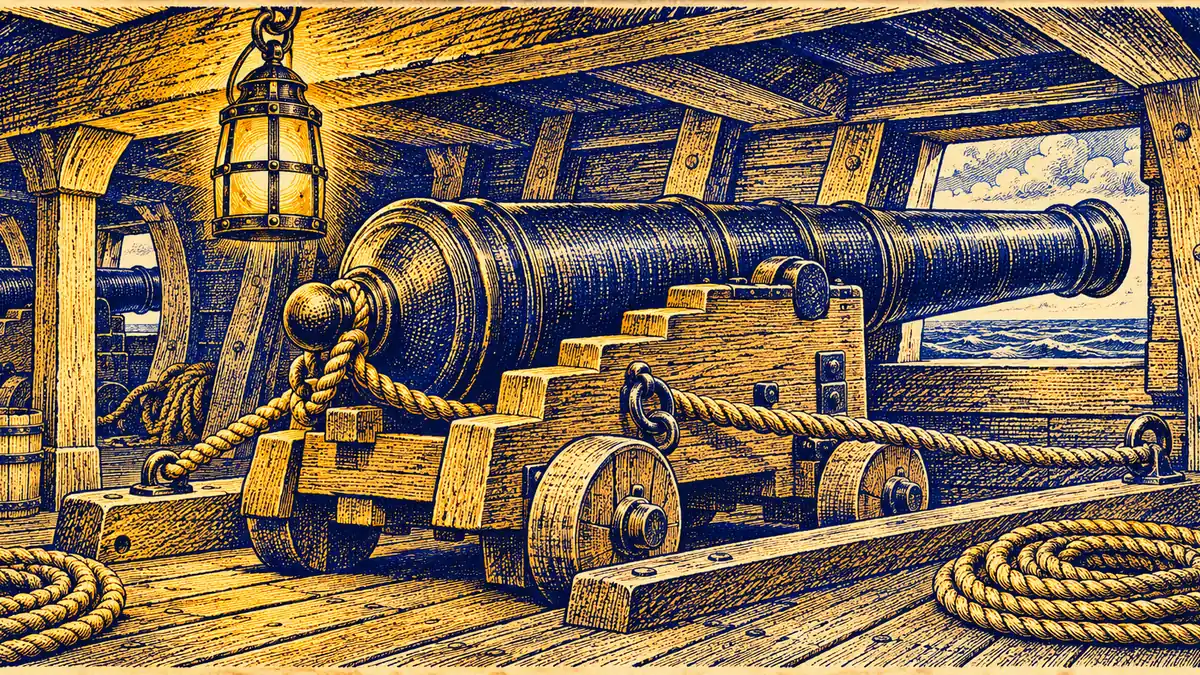
- The Gun Decks: Enclosed decks housing the main artillery batteries. Between the 24-pounder or 32-pounder guns, hundreds of men ate, slung their hammocks, and spent their off-watch hours. Clearance between deck beams was frequently under five feet six inches, so tall men had to stoop.
- The Orlop Deck: The lowest deck, located entirely below the waterline. Free from direct cannon fire, the dark orlop housed the purser's stores, the surgeon's operating cockpit during battle, and the midshipmen's berths.
- The Hold and Bilges: The damp space below the orlop, ballasted with gravel and pigs of iron. Bilge water collected here, fermenting into foul, sulfurous sludge that stank when pumped out onto the decks.
For sensory detail, begin with the constant movement and damp chill. Stockholm tar had a sharp smell; salt beef boiled in the galley copper, and oak knees groaned under wave pressure. Below decks, horn lanterns gave dim light. Candles and open flames were strictly forbidden near the powder magazine.
Masts, sails, and rigging: the mechanics of seamanship
To write a change of course, you need to understand how the sails drove the vessel forward. A full-rigged ship carried three masts: the foremast, the mainmast, and the mizzenmast, each carrying square sails hung from horizontal yards, supplemented by triangular headsails on the bowsprit.
Standing versus running rigging
Distinguish the rigging that supported the masts from the rigging used to work the sails:
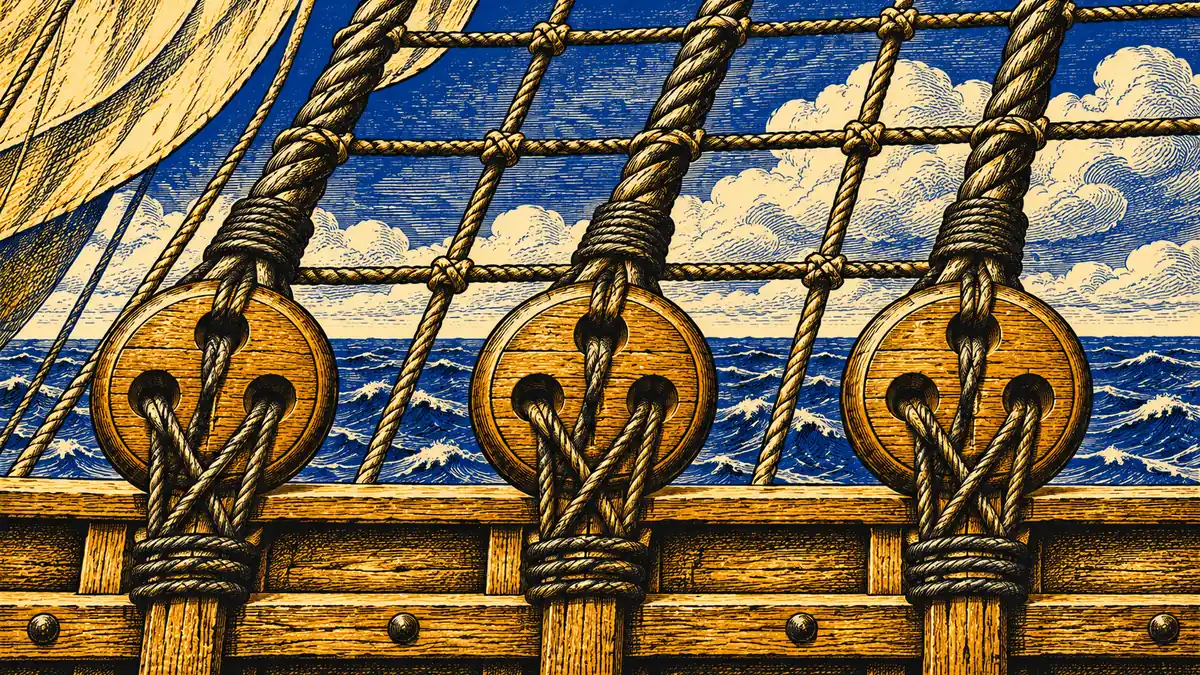
- Standing rigging: The fixed heavy cordage that held the masts in place against lateral and forward forces. Shrouds supported masts from side to side and were fitted with horizontal rope rungs called ratlines, creating rope ladders for going aloft. Stays supported masts from falling backward, while backstays prevented them from pitching forward. Standing rigging was soaked in Stockholm tar, giving it a black appearance and weather resistance.
- Running rigging: The movable ropes, blocks, and tackles used to hoist, lower, and trim the sails. Running rigging remained untarred hemp, keeping it pliable for running through sheaves. Halyards hoisted yards aloft; sheets hauled the lower corners of sails down to the decks or yards; braces rotated the yards horizontally to catch the wind; clewlines and buntlines gathered the canvas upward to the yards for furling.
John Harland explains the practical handling of these systems in Seamanship in the Age of Sail (1984), cataloged on John Harland on Open Library. Harland shows how square-rigged vessels handled changes in the wind. His diagrams cover line placements, sail combinations, and heavy-weather tactics.
Sail management and physical danger
When a captain ordered sails reefed in a rising gale, topmen climbed the ratlines, ran along the footropes suspended beneath the yards, and leaned their bellies over the spars seventy feet above rolling decks. They gathered heavy, wet canvas with their fingers, fighting wind gusts without safety harnesses. A sudden slip or a snapping line sent a man into the sea or onto the timber deck below.
A square-rigged ship had two main ways to change course across the wind:
- Tacking: Bringing the ship's bow through the eye of the wind. This was the preferred maneuver in good weather because it lost little ground, but it demanded precise timing from the entire crew to back the headsails and swing the main yards at the exact moment the ship lost forward momentum. If the ship stalled with its head to the wind, it was caught in irons, drifting backward toward danger.
- Wearing: Turning the vessel by swinging the stern through the wind. Wearing was safer in heavy gales or when short-handed, but it caused the ship to lose substantial distance downwind.
A sailing ship could not sail directly into the wind. Even a clean, well-handled square-rigger could sail within only roughly six points of it (about 67 degrees). To reach a windward destination, a captain had to tack repeatedly, making progress in a zigzag.
Naval ranks and social hierarchy: who commanded whom
Keep the Royal Navy's ranks distinct when assigning duties or writing orders. Commissioned sea officers, standing warrant officers, petty officers, and the common ship's company occupied different places in a rigid social and military hierarchy.
Commissioned officers
Commissioned officers received their appointments from the Admiralty and exercised military command:
- Flag Officers: Admirals of the Red, White, and Blue squadrons, commanding entire fleets or naval stations.
- Post-Captain: The supreme commander of a rated warship. Once an officer attained post rank, his advancement to admiral was determined purely by seniority on the captains' list, provided he lived long enough. A post-captain possessed absolute executive authority within his ship.
- Commander: An officer holding master and commander rank, assigned to command unrated sloops-of-war.
- Lieutenants: The executive assistants to the captain, ranked by seniority (First Lieutenant, Second Lieutenant, Third Lieutenant). The First Lieutenant was the ship's executive officer, managing daily routines, crew assignments, and ship discipline.
Standing warrant officers
Warrant officers were appointed by the Navy Board or the Admiralty for their technical expertise. Only the boatswain, gunner, carpenter, purser, and cook were standing officers attached to the hull itself, remaining with the ship even when paid off into ordinary reserve:
- The Boatswain: Pronounced bo'sun, responsible for masts, rigging, sails, cables, anchors, and directing physical labor on deck.
- The Gunner: Responsible for the ship's cannon, gunpowder storage, shot lockers, and training gun crews.
- The Carpenter: Responsible for hull maintenance, caulking, mast repairs, pumps, and structural integrity.
- The Purser: Responsible for all provisions, clothing, fuel, and accounting aboard. Pursers bought their warrants and operated under financial bonds, earning a living from allowable percentage margins on supplies.
- The Cook: Responsible for operating the galley, maintaining the boiling coppers, and distributing rations to the mess groups.
Other warrant officers of wardroom rank left with the commission when the ship was paid off, rather than remaining with the hull:
- The Sailing Master: A warrant officer of wardroom rank responsible for navigating the ship, surveying channels, inspecting the stowage of ballast, and directing the helmsmen during maneuvers.
- The Surgeon: Responsible for crew health, treatment of fevers, amputations during action, and general sick-berth management.
Petty officers, ratings, and marines
Below the warrant officers were the following ranks and groups:
- Midshipmen and Master's Mates: Young gentlemen training for commissioned rank, serving as division officers and signal keepers.
- Petty Officers: Experienced specialists including quartermasters at the wheel, boatswain's mates with their silver calls, sailmakers, armourers, and caulkers.
- Able Seamen: Experienced sailors who could hand, reef, and steer, capable of taking charge of aloft sails in heavy weather.
- Ordinary Seamen: Sailors with some maritime experience who handled deck lines and less hazardous aloft duties.
- Landsmen: Men with no prior sea service, assigned to heavy pulling on deck, pumping bilges, and scrubbing timber.
- Boys: Youngsters serving as servants to officers or powder monkeys carrying powder cartridges from the magazine to gun crews during battle.
- Royal Marines: A detachment of soldiers commanded by a marine officer. Marines lived between the officers' cabins and the seamen's berths. They stood guard at the spirit room and the captain's cabin door, enforced internal discipline, and provided small-arms musketry from the fighting tops during combat.
Brian Lavery describes these crew structures and their administration in Nelson's Navy: The Ships, Men and Organisation 1793-1815 (1989), cataloged on Brian Lavery on Open Library. Lavery details watch bills, uniform practices, and shipboard administration across every rate. For broader context on social class and British military mobilization during the Georgian era, consult our Regency Britain research guide.
Daily routine and the watch system
The Starboard Watch and the Larboard Watch alternated duties around the clock. These two divisions of the crew worked to a schedule marked by the ship's bell.
The 24-hour watch cycle
A standard day had seven watch periods:
- Middle Watch: Midnight to 4:00 AM
- Morning Watch: 4:00 AM to 8:00 AM
- Forenoon Watch: 8:00 AM to Noon
- Afternoon Watch: Noon to 4:00 PM
- First Dog Watch: 4:00 PM to 6:00 PM
- Second Dog Watch: 6:00 PM to 8:00 PM
- First Watch: 8:00 PM to Midnight
The two two-hour dog watches broke the four-hour rhythm between 4:00 PM and 8:00 PM. That gave each twenty-four-hour period an uneven total of seven watches, so duty rotated daily. Men who stood the exhausting middle watch one night had that period off the following night.
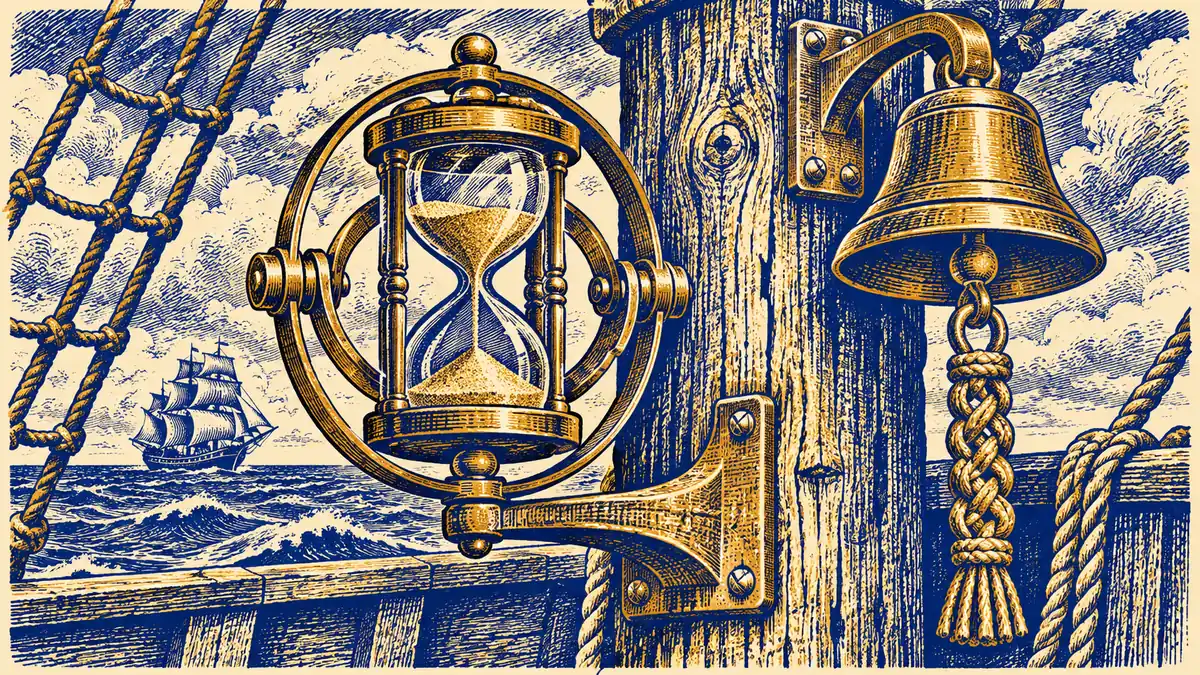
A thirty-minute sandglass measured time. Each time it was turned, a ship's boy struck the bell. One bell marked the end of the first half-hour of a watch, two bells marked the first hour, continuing up to eight bells at the end of the four-hour shift.
Daily shipboard schedule
Use this typical British warship timetable to work out what your characters would be doing:
- 4:00 AM: The morning watch was called. The boatswain's mates piped all hands to scrub the decks. Barefoot sailors dragged holystones (soft sandstone blocks) across wet timber with sand and seawater to scour away dirt and grease.
- 7:30 AM: Up all hammocks. Men unhooked their canvas hammocks, lashed them into tight sausage shapes with seven turns of cord, and carried them to the upper deck to stow in the bulwark nettings, where they provided splinter shields in combat.
- 8:00 AM: Breakfast, consisting of ship's biscuit and burgoo (thick oatmeal porridge).
- 9:00 AM: Divisions and inspection. The crew lined up in clean trousers and frocks for division officers to inspect hygiene and clothing.
- 10:00 AM: General quarters, gun drill, sail trimming, and maintenance work such as splicing ropes and picking oakum from old ropes for seam caulking.
- Noon: The captain and master took the noon solar sight with octants or sextants to establish latitude. The master reported eight bells, and the captain officially made it noon. The crew was piped to dinner.
- 12:30 PM: The first grog issue of the day.
- 1:30 PM to 4:00 PM: Afternoon duties, continued gun drill, or tradesmen repairs.
- 4:30 PM: Supper, followed by the second grog ration.
- 8:00 PM: Night watches set, rounds made to check fire safety, and the off-watch slung hammocks on the crowded lower decks.
Hammocks were slung from hooks set roughly fourteen to twenty-eight inches apart. In warm southern climates, the lower decks grew humid and foul, while in winter latitudes, condensation dripped constantly from the deckheads onto sleeping men.
Food, drink, and health: life between the beams
A 74-gun ship carried food and water for 600 men for months at sea. Supplying that much food, and keeping it fit to eat, was a major logistical problem.
The naval food allowance
The official weekly allowance per man under the Victualing Board included:
- Four pounds of salt beef and two pounds of salt pork.
- Seven pounds of ship's biscuit (hardtack).
- Two pints of pease and three pints of oatmeal.
- Six ounces of butter and twelve ounces of cheese.
- Seven gallons of small beer, or equivalent rations of wine or rum when outside home waters.
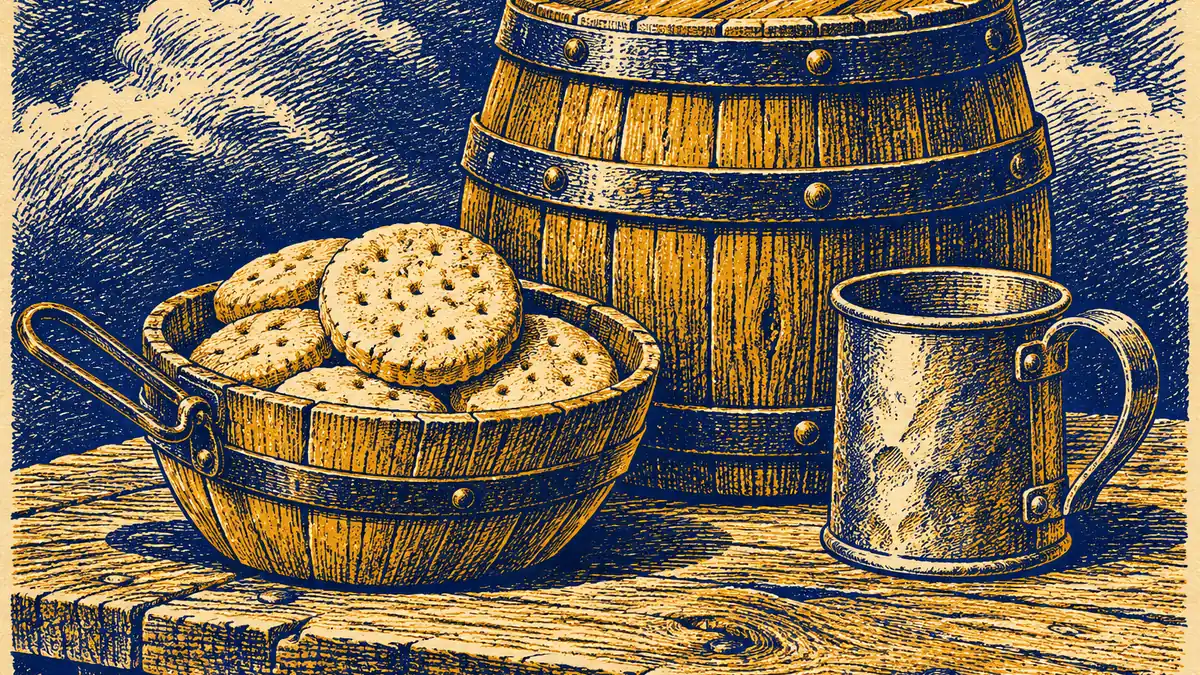
Salt meat kept in brine in wooden casks. After months at sea, the beef issued to the men was rock-hard and coated in salt crystals. Cooks soaked it in tubs of seawater to draw out excess salt before boiling it in the ship's coppers. Hardtack, baked from flour and water and dried until brittle, became infested with weevil beetles and maggots. Sailors routinely tapped biscuits on the mess tables to dislodge insects before eating. Sometimes they broke them into pease soup in the dark.
Grog and water supplies
Fresh water carried in wooden casks quickly turned stagnant, growing algae and slime. To make water drinkable, the Navy relied on alcohol. In 1740, Admiral Edward Vernon ordered that the daily rum allowance be mixed with water and citrus juice rather than served neat. His sailors nicknamed Vernon "Old Grog" because of his grogram cloak, and the diluted drink became known as grog.
A standard grog issue mixed one half-pint of rum with one quart of water, divided into two daily servings under the watchful eyes of the purser and a lieutenant. Lime or lemon juice was added to ward off scurvy, though the Admiralty did not formally mandate daily lemon juice across the entire fleet until 1795, decades after James Lind published his medical trials.
N. A. M. Rodger analyzes these victualing systems, living standards, and the social contracts of the fleet in The Wooden World: An Anatomy of the Georgian Navy (1986), cataloged on N. A. M. Rodger on Open Library. Rodger challenges the picture of eighteenth-century warships as perpetual floating dungeons. He shows that naval crews often ate better and received more regular medical attention than agricultural laborers ashore.
Keep a list of the shipboard terms you use and each character's vocabulary, so both stay consistent throughout the manuscript.
Discipline and naval law: dispelling the mutiny cliché
Popular fiction often gives us a tyrannical captain who orders daily floggings on a whim. Historical records show a harsh penal system, but also written laws and records that captains had to answer for.
The Articles of War and flogging
Parliament established the Articles of War as the Royal Navy's statutory code. The assembled ship's company heard the Articles read aloud once every month. Many articles concluded with the stern warning that offenses were punishable by death or such other punishment as the nature and degree of the offense shall deserve.
A captain's standard summary punishment was flogging with the cat-o'-nine-tails. It followed a prescribed ceremony:
- The hands were piped to witness punishment on the quarterdeck.
- The marine guard stood under arms with fixed bayonets.
- The offender was stripped to the waist and lashed by his wrists to an upright wooden grating.
- The captain read aloud the specific Article of War that had been violated.
- Boatswain's mates administered the lashes across the prisoner's bare back, alternating after each dozen lashes.
Admiralty regulations required captains to record every flogging in the official ship's logbook, including the sailor's name, offense, and exact number of lashes. At the end of each commission, the Navy Board received the logbooks for audit. Typical punishments ranged from a dozen to thirty-six lashes for drunkenness, neglect of duty, fighting, or disobedience. Floggings of hundreds of lashes could only be awarded by a formal court-martial, not by an individual captain.

Excessive brutality could damage a captain's career. Crews could petition the Admiralty, refuse duty during peacetime, or take advantage of fleet inspections to lodge formal complaints.
Courts-martial
Capital crimes such as mutiny, desertion, murder, striking an officer, or the loss of a vessel were reserved for courts-martial. A panel of post-captains presided over a court-martial aboard a flagship. A judge advocate recorded the proceedings verbatim and forwarded them to the Admiralty.
For writers researching operational commands and administrative decisions, The National Archives guide on Royal Navy operations covers Admiralty correspondence, including admirals' letters and operational dispatches in ADM 1, ADM 2, and ADM 13.
Essential reference books and primary archives
Keep reference books close to hand for technical questions, then use primary records to research the vessel and events your story needs.
The core reference shelf
These four books cover vocabulary, ship handling, and life aboard:
- William Falconer, An Universal Dictionary of the Marine (1769): An eighteenth-century primary glossary of spars, ropes, anchors, ship types, and naval maneuvers as contemporary seamen understood them. Falconer was a working sailor and naval purser who documented terms before industrial steam power changed the language. Consult William Falconer on Open Library.
- N. A. M. Rodger, The Wooden World: An Anatomy of the Georgian Navy (1986): A social history of the eighteenth-century Navy that covers officer patronage, crew origins, victualing logistics, and disciplinary records.
- Brian Lavery, Nelson's Navy: The Ships, Men and Organisation 1793-1815 (1989): An encyclopedic guide to vessel architecture, armament, dockyard operations, uniforms, and tactical deployment during the Napoleonic era.
- John Harland, Seamanship in the Age of Sail (1984): A manual on ship handling that explains how square-riggers tacked, wore, anchored, weathered storms, and deployed sails.
Primary archives and museum collections
For original documents, start with these two institutions:
- The National Archives (Kew, United Kingdom): Holds the official Admiralty archives under record series ADM. Key series for novelists include Captains' Logs (ADM 51), Masters' Logs (ADM 52), Ship's Muster Books (ADM 36 and ADM 37), and Courts-Martial Proceedings (ADM 1).
- Royal Museums Greenwich (London): The National Maritime Museum and the Caird Library preserve thousands of original ship draughts, admiralty construction plans, journals, and logs. Find their research tools in the Royal Museums Greenwich research guides.
Read a ship's logbook for the captain's descriptions of weather and daily distances measured by log line. Entries also record the deaths of seamen and the receipt of fresh bullocks in foreign ports.
Common nautical mistakes novelists make
Readers who know naval history will notice misused maritime terms. Check these details before you finish a scene:
- Calling every vessel a ship: In maritime terminology, a ship was specifically a vessel with three square-rigged masts (fore, main, and mizzen) carrying a bowsprit. A two-masted square-rigged vessel was a brig or a snow; a two-masted vessel with fore-and-aft sails was a schooner; a single-masted vessel was a cutter or a sloop. Referring to a brig or a cutter as a ship is an immediate error.
- Using knots per hour: A knot is a unit of speed equal to one nautical mile per hour. Saying that a frigate made ten knots per hour is redundant. Write that the frigate made ten knots.
- Using the word rope: Sailors rarely used the generic word rope aboard ship. Cordage had specific functional names: halyard, sheet, brace, lift, stay, shroud, lanyard, painter, or line. The word rope appeared in only a few specific items, such as the bell rope, bucket rope, manrope, and footrope.
- Using port instead of larboard: In the Georgian and Napoleonic Royal Navy, the left side of the ship looking forward was called larboard, while the right side was starboard. Although commercial sailors sometimes used port, the Admiralty did not officially mandate the term port to replace larboard until 1844, when the order was issued to prevent verbal confusion between larboard and starboard during gunfire.
- Dropping anchor in deep open water: Sailing ships anchored only in shallow coastal waters, roadsteads, and sheltered bays, generally in depths under thirty or forty fathoms (180 to 240 feet). Dropping anchor in the open Atlantic was impossible because ships did not carry enough anchor cable to reach bottom, and ocean swells would have broken the cable immediately.
- Confusing the sailing master with the captain: The captain was the military commander of the vessel. The sailing master was the warrant officer responsible for navigating, trimming sails, taking sights, and overseeing steering.
- Anachronistic chronometers and sextants: Marine chronometers for calculating longitude were rare and expensive in the mid-eighteenth century. Captains in the 1750s relied on dead reckoning and latitude sights, with lunar distances coming into use from the late 1760s after the Nautical Almanac first appeared in 1767. Sextants and reliable marine chronometers became common naval equipment only toward the end of the eighteenth century.
Worked dialogue and scene examples: before and after
Use period terms where they help readers follow the action. The passages below show how deck geography, orders, and rations can make a scene more precise.
Example 1: Quarterdeck maneuver in heavy weather
Before: The captain stood on the windward side of the quarterdeck in the storm. He lifted his speaking trumpet and told the crew to wear ship, then to ease the main sheet and square the yards away. The topmen went into the shrouds to shorten sail while spray washed across the waist. They moved quickly through the storm and the spray.
After: The captain stood on the windward side of the quarterdeck and raised his speaking trumpet against the gale. "Hands wear ship!" he called. "Ease the main sheet and square the yards away!" The topmen scrambled into the shrouds to shorten sail, bracing against the spray that washed across the waist.
The revision keeps the same maneuver, people, weather, and deck locations. Direct orders and shorter sentences let the reader follow the action without repeating the storm and spray. For help with period cadence, see writing historical dialogue.
Example 2: Describing crew rations between decks
Before: Jack sat at an oak table between the 18-pounders with his messmates. He tapped his hard ship's biscuit on the table to shake out the weevils. His cold salt beef sat in a wooden mess kid and was very hard. A boy brought the diluted grog ration, and Jack drank his allowance from a measured tin pot.
After: Jack sat with his messmates between the 18-pounders, tapping a ship's biscuit against the oak table to shake out the weevils. His salt beef sat cold in the wooden mess kid, as hard as seasoned mahogany. When the boy brought the mess's grog ration, Jack took his measured tin pot and drank his diluted allowance down.
The revision keeps the meal, its location, and Jack's actions. It uses the texture of the biscuit and beef to carry the discomfort instead of telling the reader that the food was hard. If the scene leads into an armed boarding action or deck combat, use these details alongside the advice on spatial pacing in how to write fight scenes.
Step-by-step method: how to build an authentic shipboard scene
Before drafting dialogue or combat, work through these five checks in order:
- Establish the ship's rate and location: Note the number of guns, the deck layout, and the distance from shore. A frigate hunting in coastal waters faces different hazards and command structures than a third-rate ship of the line riding out a gale in the middle of the Atlantic.
- Check the watch bill and current bell: Determine which watch is on deck and who is sleeping below. Note the position of the sun or stars, the state of the sandglass, and which bell was last struck.
- Identify who is on deck and where they stand: Respect quarterdeck social boundaries. Place the captain and officer of the watch on the windward side, junior officers and midshipmen on the leeward side, the quartermaster at the wheel, and seamen in the waist and forecastle.
- Verify the wind and named lines: Check the relative wind direction. If the ship is sailing close-hauled, identify which yards are braced sharp up. When an order is given to alter sail, use Falconer's dictionary to name the specific lines (halyards, sheets, braces, or clewlines) rather than generic ropes.
- Ground the physical environment: Establish the sensory details of the moment: the motion of the hull, the smell of bilge water and Stockholm tar, the low clearance of the deck beams, and the sound of straining rigging blocks before the characters speak.
Frequently asked questions about Age of Sail research
Did sailors in the Royal Navy eat salt meat and hardtack every single day?
On long sea voyages, sailors depended on salt provisions and biscuit. When ships were in port, anchored in home roadsteads, or operating near friendly coasts, the Victualing Board supplied fresh provisions. Agents bought fresh beef on the hoof, local vegetables, fresh loaves of bread, and casks of fresh beer from local contractors. Salt provisions were reserved for long passages where fresh food could not survive.
What was the practical difference between a commander and a post-captain?
Both officers received the courtesy title of Captain aboard their own ships, but they held different ranks. A commander held the intermediate rank of master and commander, assigned to command unrated vessels such as sloops and brigs. A post-captain had achieved full rank on the official captains' seniority list and commanded rated warships from sixth rates up to first rates.
Was impressment as violent and universal as portrayed in popular fiction?
The Impress Service (the press gang) was an official, legally authorized method for manning the fleet in wartime, but statute law placed limits on its reach. The press gang targeted professional mariners, merchant sailors, watermen, and dockworkers who already had sea skills. Taking landsmen, apprentices, or gentlemen was illegal and subject to civil prosecution. While press gangs used physical force to detain merchant seamen arriving in home ports, volunteer sailors and transfer recruits made up a substantial percentage of many crews.
How can a novelist research a specific historical Royal Navy vessel?
Start by consulting David Lyon's The Sailing Navy List or Rif Winfield's British Warships in the Age of Sail to confirm the ship's builder, launch date, dimensions, armament, and decommission dates. Next, search The National Archives online catalogue (Discovery) for the ship's official logs in series ADM 51 (Captains' Logs) or ADM 52 (Masters' Logs). These records provide daily entries written during the vessel's commissions, noting weather, disciplinary floggings, provisioning, and combat actions.
How should an author handle nautical jargon without confusing general readers?
Put the term beside the action it describes. After an order to brace the yards, let the reader follow men straining on hemp cordage. The wooden yardarm groans as it swings into the wind; the hull heels when the sails catch air. A reader can follow the maneuver through those actions without stopping for an explanatory footnote.