Historical Clothing for Writers: A Research Guide
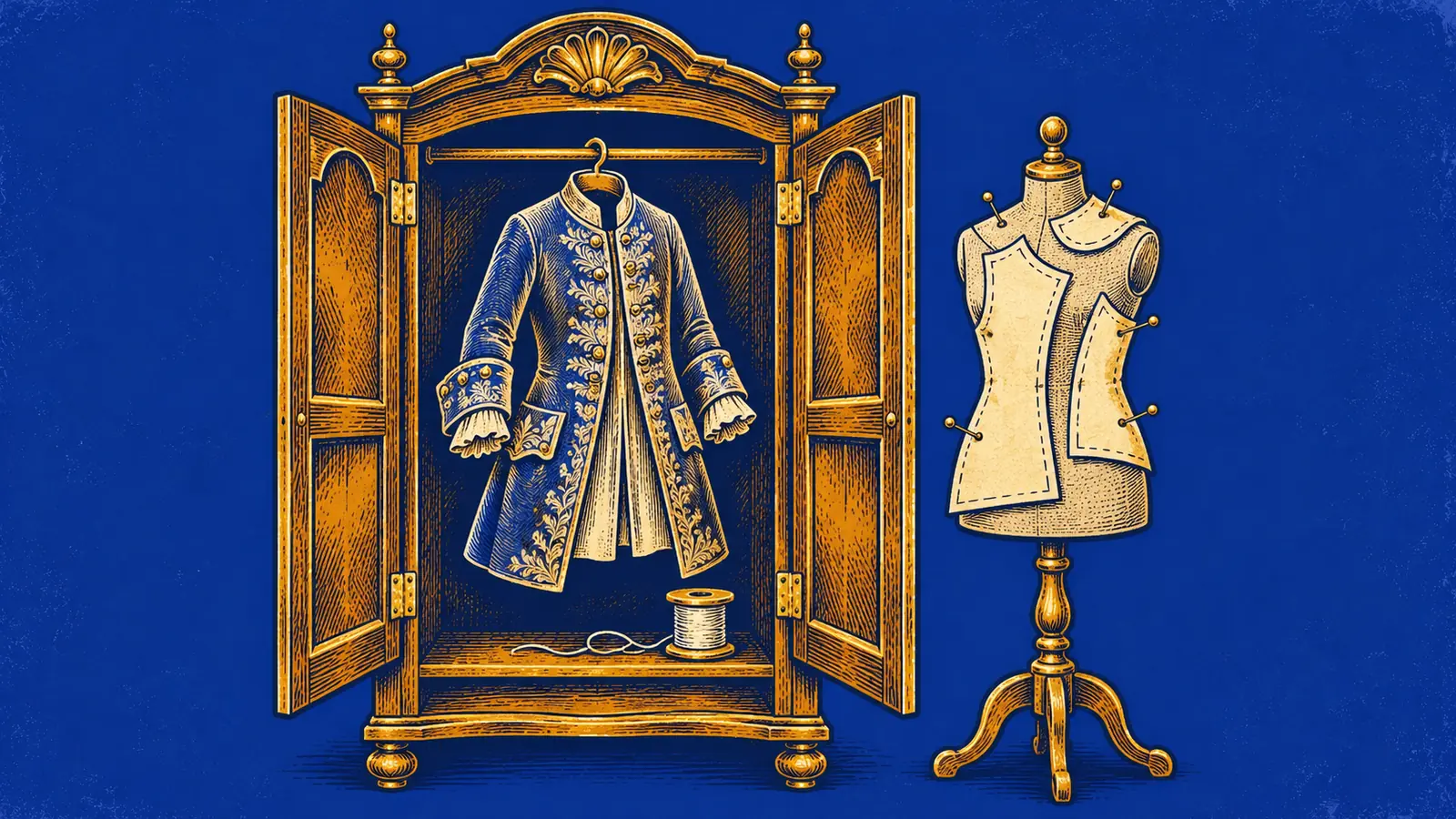
A historical character needs clothes that fit the place, year, social position, and occasion. Start there, then compare a dated garment or image with construction evidence and a source from the period. Before describing the outfit, work out its layers and fastenings and check the words used for them. Even a beautiful picture leaves practical questions unanswered. Can your character reach a pocket? Can they remove the coat or dress without help?
The sources here cover British and western European clothing from the medieval period to the Edwardian era. The method also works elsewhere, but the garment names and examples need local evidence. An English wardrobe is not a substitute for research into another country's dress.
Start with a character, not an era label
Search for medieval clothing or Victorian dresses and you will find more outfits than any scene needs. Give the search some limits before opening a collection catalogue:
- Time and place: A specific year or narrow range, plus the town, region, and country.
- Wearer: Age, occupation, resources, and position within the household.
- Occasion: Work, travel, worship, visiting, celebration, or private rest.
- Conditions: Season, weather, indoor temperature, and expected physical activity.
- Story requirement: What the clothes must allow, conceal, reveal, or complicate.
For a scene in which a clerk hides a letter, the immediate question is where the letter can go and whether he can retrieve it unnoticed. For a dressing scene, the question may be which fastenings the wearer can reach. Those questions call for different evidence, even if the characters live in the same street.
A garment made in your chosen year proves that it existed. Whether your character could have bought or worn it is another question. Decide how each important item reached the wardrobe: was it bought new, borrowed, inherited, altered, or kept for a particular occasion? If that choice affects the character's social position, check that the evidence supports it.
If the place and social setting are still unsettled, begin with the broader process in how to research a historical novel. Knowing whose wardrobe you need will narrow the search.
Build a small evidence packet for each important outfit
Build the outfit from three kinds of evidence: an object or image that shows its appearance, construction evidence that explains how it works, and a period source that records how people described or used it. Expect some disagreement. Before deciding that a source is wrong, check its country, occasion, and date. It may simply be answering a different question.
Read museum records beyond the photograph
Start with the collection record linked from a museum's article or exhibition. Copy the accession number, date range, place attribution, materials, and any alteration notes into your research file. Preserve qualifiers such as probably and about. A catalogue date of about 1815 does not establish that the item existed in precisely the same form in 1805.
Inspect every available view. The front may give you silhouette and decoration; the back may show closure; an interior view may reveal lining or reinforcement. If the record provides only a front photograph, leave the fastening unresolved instead of drawing one from memory.
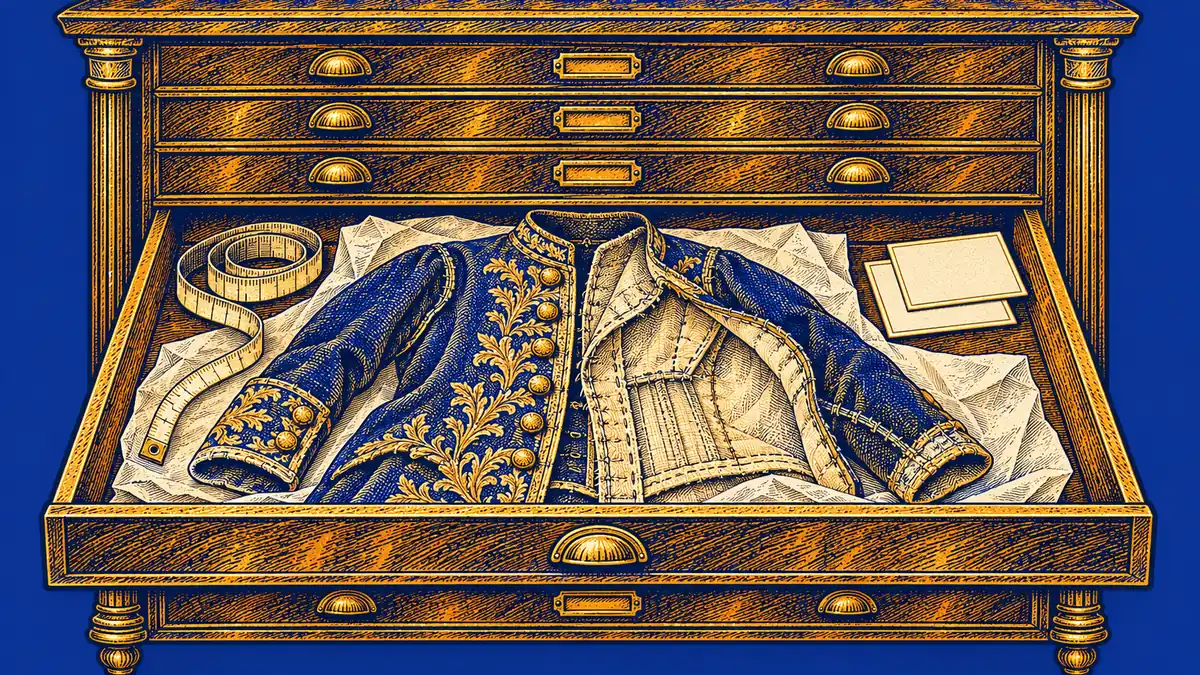
Ask what belongs to the object and what belongs to its display. Are the shoes and accessories separately catalogued? Is an understructure identified? Does the record say that a section was replaced? Unless the record supports it, you cannot assume that one person wore the whole display together.
Museum labels help people find objects in a catalogue. The noun in a title may be broad, while the description below gives a more precise name. Save both. Check period vocabulary separately before putting either word into a character's mouth.
Use patterns to investigate physical actions
LACMA's Costume and Textiles Pattern Project offers downloadable patterns drawn from garments in its collection, with contextual descriptions, photographs, and construction instructions. Its examples include a French man's frock coat dated about 1815 and an English woman's coat dated about 1885. These are useful starting points for studying cut rather than guessing from an exterior photograph.
You can read a pattern without making the entire garment. Identify the body pieces, sleeves, openings, and attachments. Follow the instructions far enough to understand which edges join and which remain accessible. Sketch the fastening sequence in ordinary words.
A pattern can help you ask whether a pocket is reachable while the coat is closed. It cannot, by itself, establish that every wearer found the coat comfortable or that your character owned that particular cut. Use the pattern to explain the pocket; find other evidence for comfort and ownership.
Choose pattern books by their evidence
Before borrowing or buying a pattern book, inspect its date range, geographical scope, and explanation of method. Look for measured drawings tied to identifiable surviving garments, clear scales, interior details, and discussion of uncertain reconstruction. The words historical costume on a cover tell you little about how the author developed the patterns.
Distinguish a modern pattern taken from an old garment from a tailoring manual published during the period. The first interprets a surviving object. The second records a method offered to its original readers. Both can help, but neither automatically supplies a complete wardrobe for every class or occupation.
Also distinguish dressmaking patterns from embroidery or textile pattern books. The latter may answer a question about ornament without showing how the garment closes. Check that the book answers your scene's question before spending hours with it.
Read period sources for purpose and vocabulary
The V&A's account of nineteenth-century fashion plates shows how dated prints from fashion journals can document styles circulating at a particular moment. Use a plate close to your setting, then record its publication and date when those are supplied.
Read the caption as carefully as the image. Evening wear and walking clothes answer different questions about a character's wardrobe. Record the occasion beside the image; months later, you may remember the attractive sleeves and forget where the outfit was meant to be worn.
For each source type, ask a different question:
- Fashion plates and advertisements: What look or product is being offered, and to whom?
- Household accounts and bills: What was acquired, made, repaired, or paid for in this household?
- Inventories: What garments or materials were recorded, and how detailed is the description?
- Letters and diaries: What did this person notice about dressing, expense, fit, or appearance?
- Tailoring and dressmaking instructions: How was the item intended to be constructed?
- Portraits and photographs: What can actually be seen, and what does the pose conceal?
An advertisement is evidence of an offer, not proof of universal ownership. An inventory may establish possession without telling you how the item fitted. A satirical image requires particular care: identify the joke before treating its proportions as a reliable guide to ordinary clothing.
Keep the original spelling in your evidence notes when a word matters. If you work from a translation, preserve the original term alongside the translated one where possible. You can then distinguish a historical word from a translator's convenient modern substitute.
Narrow the search for each period
Within each period, look for evidence close to your story's date and locality. Taking attractive details from across a century can leave you with an outfit that belongs to no particular year.
Medieval clothing: date the image as well as its subject
Getty's exhibition on fashion in medieval manuscripts explains that illuminations can contain observed fashions, idealized dress, and conventions for representing figures from another time or place. A picture of a biblical event therefore needs two dates in your notes: the date of the depicted event and the date the image was made.
For a medieval outfit, compare images made near your setting and look for repeated construction clues. Where does the garment open? How are sleeves attached or shaped? What is visible at the neck, wrist, or hem? Mark a feature as uncertain if it appears only once or cannot be distinguished from a painted fold.
A convincing modern reconstruction still needs to explain its hidden layers. Ask which parts come from surviving material, which from images, and which are practical reconstruction choices. For English settings, the medieval England research guide helps connect the wardrobe question to household and local records.
Tudor and Stuart clothing: investigate the layers separately
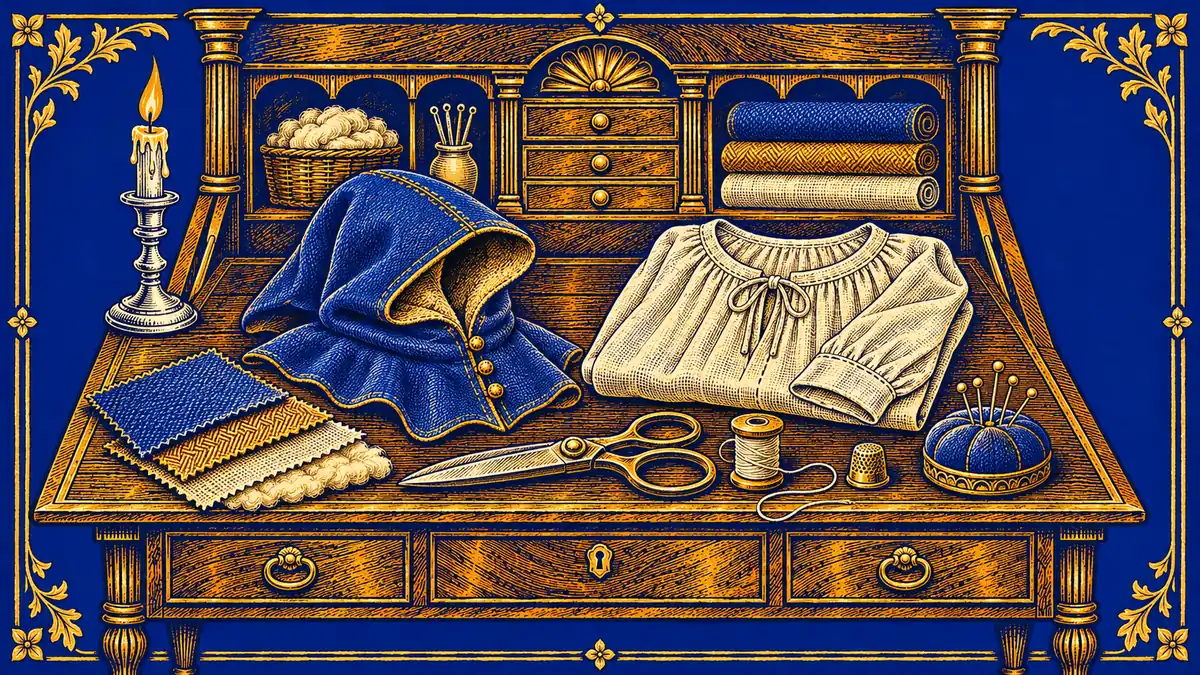
For sixteenth- and seventeenth-century scenes, start a separate note for the visible garment, any supporting structure, and the layer next to the skin. Search each component by date and locality. A fitted torso in a portrait can otherwise tempt you to assume a later corset underneath.
Search terms worth investigating include bodies, doublet, hose, and farthingale. Use them to find dated records before deciding which belong in the outfit. When a source uses a familiar noun, inspect the actual object or description before assigning it a modern shape.
A portrait may be enough to support a brief visual description. A scene in which someone undresses, changes sleeves, hides an object, or helps another person dress needs evidence of openings and attachments. The more the action depends on a garment, the more you need to know about its construction.
Georgian and Regency clothing: separate shape from terminology
The Museum at FIT's historical lingerie exhibition shows eighteenth-century petticoats that could serve as visible clothing as well as underclothing. It also presents a corset dated about 1815 and discusses an 1811 fashion description using the word corset. So a petticoat need not be hidden, and the word corset is not automatically wrong in a Regency scene.
For a scene involving an open-front gown, determine which visible textile belongs to which garment. For an early nineteenth-century outfit, compare its support garment with the outer dress instead of attaching a later hourglass outline to it.
Then connect the outfit to resources and occasion. Our Regency Britain research guide covers the social and household context that a clothing catalogue cannot supply on its own.
Victorian clothing: choose the year before the skirt support
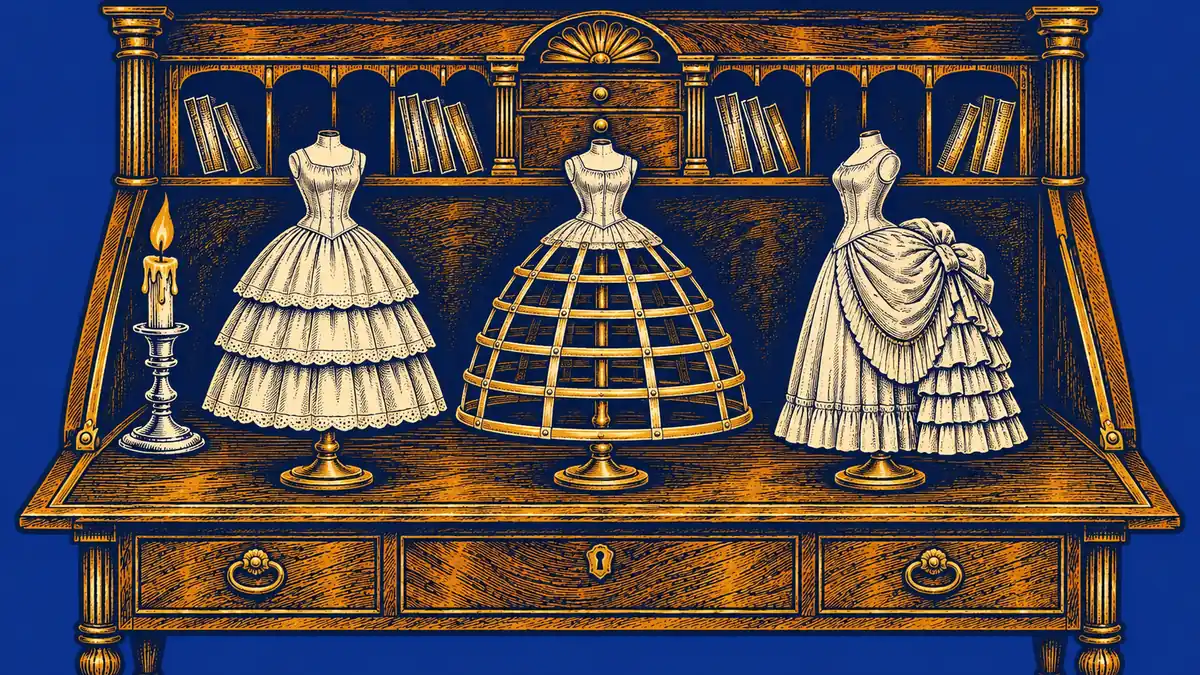
The V&A's account of Victorian underwear traces changing arrangements of petticoats, cage crinolines, crinolettes, and bustles. It places the cage crinoline's emergence in 1856 and describes the later shift of skirt volume toward the back. A single generic Victorian outfit cannot represent those changes.
Make separate notes for the outer skirt and what supports it. If a scene depends on sitting, crossing a narrow space, or getting into a vehicle, find evidence for the particular structure. Do not infer the mechanics of every skirt from the widest example in a museum gallery.
Edwardian clothing: investigate occasion as well as silhouette
FIT's overview of clothing from 1900 to 1909 describes both the changing fashionable silhouette and tailored suits worn by working and wealthy women. It also distinguishes men's daytime and evening clothing. Choose what the character is doing before assembling the outfit.
Create separate reference sets for a character's working day, formal visit, and outdoor pursuit. Compare the beginning and end of the decade if your story spans several years. Check a photograph's date before using it: clothing from late in the decade may not suit a scene near its beginning.
Garment words that deserve their own research note
A useful clothing glossary records the object, date, locality, source term, and word you plan to use in narration. Add a separate column or line for dialogue if the character uses a different expression. You should be able to trace each word back to the evidence that supports it.
Corset versus stays
Avoid a rigid rule that stays belongs to one century and corset to the next. The V&A uses both terms in its Victorian discussion; the FIT example above places corset in an early nineteenth-century fashion description. Search both words, then investigate usage in your chosen setting.
Neither noun tells you exactly how a garment was built. You still need to establish its length, stiffness, and fastening, along with how it affected movement. Keep those details in your notes before writing action that depends on them.
Petticoat
Do not equate petticoat with a hidden modern slip. In the eighteenth-century examples discussed above, a petticoat could form the visible front of an ensemble. If a character admires its colour or catches its hem, establish which layer is exposed.
Replacing every historical occurrence with skirt can also cause confusion, especially when the scene depends on the relationship between garments. A brief physical cue can show readers which layer you mean without stopping the action for a definition.
Crinoline, bustle, and busk
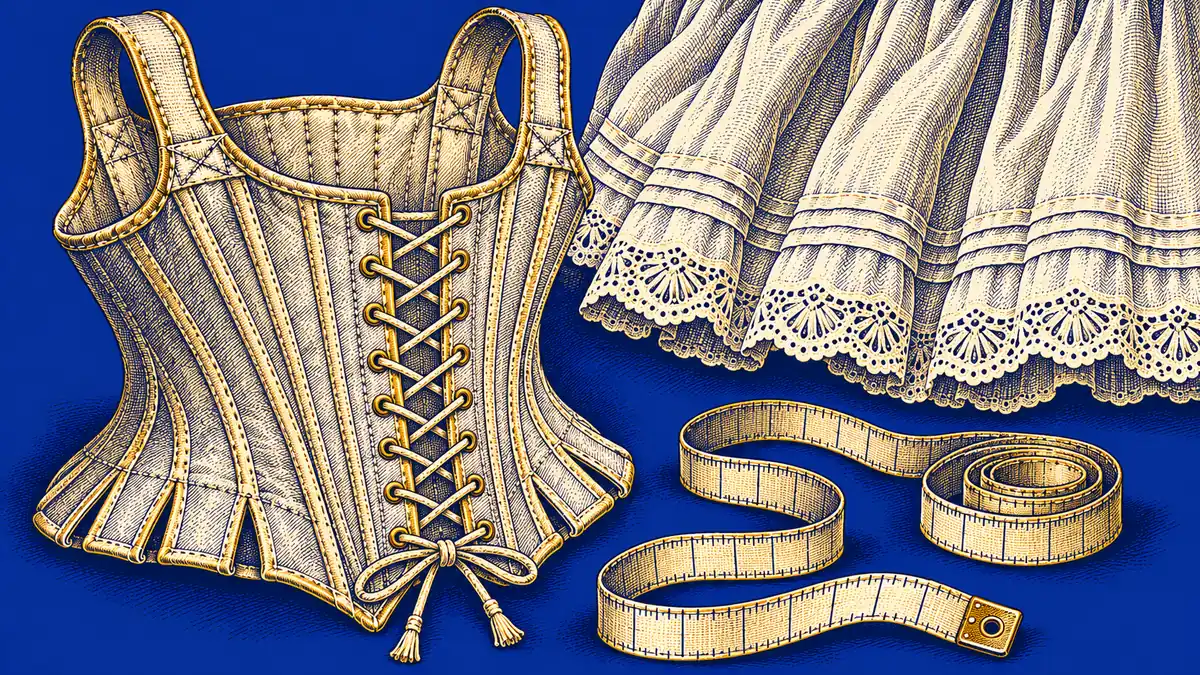
Crinoline needs context: the V&A describes its use for a horsehair-and-linen fabric before the name became associated with the supporting garment. Bustle refers to support emphasizing the rear. A busk is a different component, associated with the front of a corset or stays. Take care with these similar-sounding names; they refer to different things.
When your scene needs a fastening, identify that fastening directly from the object's construction. A general garment name is not evidence for a particular release mechanism.
Doublet, bodice, coat, and gown
Keep these words tied to their dated examples. A modern picture search cannot tell you what a word meant in every period. Ask what part of the outfit the source means and whether the term is the catalogue's label or the wearer's vocabulary.
For dialogue, check the context as described in writing historical dialogue. A word can be available in the period without being the natural choice for every speaker.
Work through one scene before researching a whole wardrobe
Consider a scene in which a woman arrives for a visit wearing an open-front gown and a visible blue petticoat. Her hem catches on a chair as she stands. The story needs the snag and her response; it does not need a tour of every layer.
Write down what the scene already requires: the gown opening, visible blue fabric, chair, and snag. Then list what you still need to research. Does the outfit suit the chosen year and the visit? Which garment's hem catches? These questions give the search a stopping point.
A useful research sequence is:
- Find a dated ensemble or image compatible with the setting and occasion.
- Identify the visible petticoat rather than assuming all blue fabric belongs to the gown.
- Inspect construction evidence for the relevant hem and the relationship between layers.
- Decide exactly which garment catches, then keep that noun consistent through the action.
- Remove any sentence that requires a fastening or movement you have not resolved.
The action needs to be easy to follow:
Before: She was wearing an open-front gown with a blue petticoat visible beneath it. When she stood up, the hem of the petticoat caught on the chair, and she stopped to free it.
After: She wore an open-front gown over a visible blue petticoat. As she stood, the petticoat's hem caught on the chair. She stopped to free it.
In a dressing scene, a man removes his coat while holding a candle. Track both hands before polishing the description. Where does the candle go? What must open first? Is he taking the coat off entirely or merely loosening it? Resolve the physical sequence before choosing more elaborate garment vocabulary.
Ordinary objects and a sketch can help you check where the hands go. They cannot establish how the historical garment behaved. If the plot depends on a specific closure, you still need construction evidence for it.
Make clothing reveal a particular person
Once the outfit is plausible, decide what the viewpoint character would notice. A person responsible for repairing clothes may notice a weak seam. Someone trying to conceal a stain may watch where the light falls. A visitor worried about belonging may compare their own clothes with those of the host.
Let that attention suggest the emotion without naming it again. A sleeve that interrupts a task gives the reader something to follow; a paragraph cataloguing every trim may only delay the task.
Track changes between scenes. If a character leaves an outer garment behind, it cannot supply a pocket in the next chapter. If a fastening breaks, record the repair or continue to account for the damage. Check these details alongside injuries, possessions, and travel time when reviewing continuity.
For an ensemble cast, keep a small vocabulary sheet. The Writing Desk's guide to keeping terminology consistent across a long document offers a useful method for recording preferred terms and reviewing individual occurrences. In fiction, leave room for deliberate differences between speakers while keeping the underlying garment clear.
Common research mistakes to catch in revision
Combining several dates into one outfit. Keep an image's date attached when you save it. A folder called beautiful dresses makes it easy to mix periods. Record the date, place, occasion, and unanswered questions with each image so you can check whether it belongs in the scene.
Giving everyone the museum's most elaborate garment. Check whether the object suits the character's circumstances. If the evidence does not support the choice, look at records for the relevant occupation or household. Simply imagining the same garment with less ornament does not establish that someone in that position wore it.
Making all historical clothing painful or effortless. Either claim needs evidence. If the scene calls for difficulty moving or dressing, check that the garment and the situation support it.
Confusing absence with impossibility. A missing interior photograph leaves you uncertain about the interior. It does not prove the absence of a pocket, lining, or reinforcement. Mark the gap and seek a better source if the scene needs it.
Using an unfamiliar noun without orientation. Give enough context to locate the object on the body or within the action. Readers should not need to leave the novel to understand which garment has been torn.
Researching decoration while ignoring use. Buttons, embroidery, and colour are tempting search subjects. If the scene concerns escape, dressing, concealment, or work, prioritize openings, reach, layers, and physical sequence.
Frequently asked questions
How much clothing research is enough before drafting?
Enough to establish a plausible outfit and resolve the actions the scene depends on. Leave minor decorative choices open if they do not affect the plot. Investigate a closure before writing a scene built around removing it; a passing description may need much less detail.
Can I use a costume drama as a reference?
Use it to identify questions and visual preferences, then trace the relevant details to dated evidence. The image alone will not tell you where its costume details came from. You need a production explanation or an underlying source to distinguish historical choices from those made for performance or visual storytelling.
Must I learn to sew?
No. Learn to recognize openings, seams, linings, and the basic relationship between pattern pieces. Ask a knowledgeable maker about an important construction problem when necessary, and request the evidence behind the answer. You need enough understanding to describe the action accurately, not a finished costume.
Should a historical novel explain every garment term?
Explain only what readers need for the immediate action. A brief cue about location or function usually works better than an inserted lecture. Save the full definition and source for your notes, where you can retrieve them during revision.
What if reliable sources disagree?
Check whether they describe the same date, country, occasion, and type of wearer. Check, too, whether each source records direct observation, a reconstruction, or an interpretation. If the disagreement remains, preserve the uncertainty in your notes and avoid making the disputed detail essential to the plot without further evidence.
What should I save for each outfit?
Save the reference image or record identifier, its date and location, materials, known layers, fastening notes, vocabulary choices, and unresolved questions. Add the scenes in which the outfit appears. Keep the record compact enough to consult while drafting, with the evidence beside the scene that needs it.