 Gryphon Books for Writers
Arms and Armor for Writers: A Practical Reference Guide
U799–897 Library of Congress browsing range for History of arms and armor. Check your library’s catalog for each book’s call number.
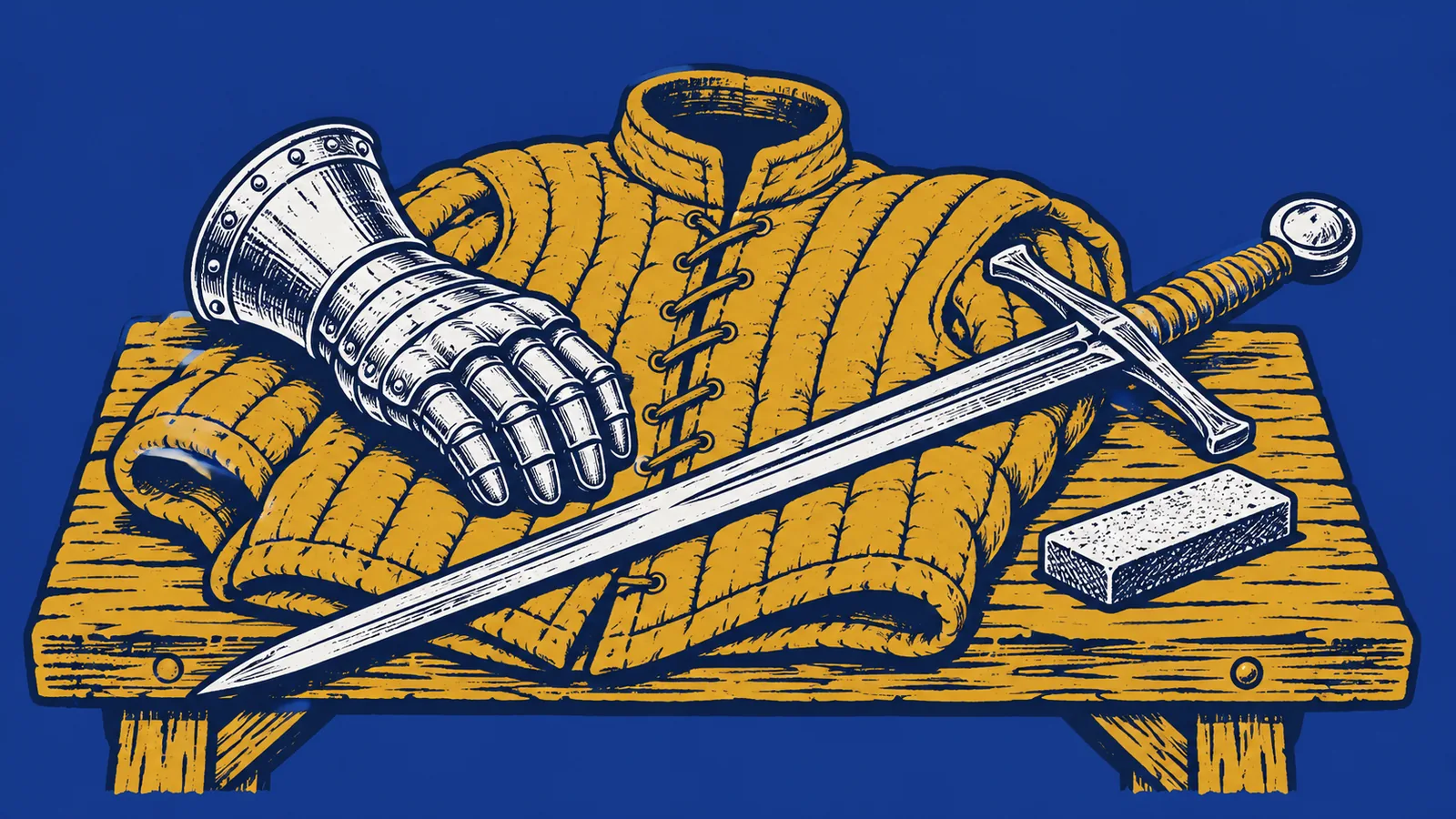
The cinematic myth of clumsy combat
Cinema has spent decades teaching audiences to misunderstand medieval warfare. Armored warriors stagger like deep-sea divers, swing six-pound iron bars, and collapse helplessly when knocked to earth. A single sword slash cuts through polished steel as if opening a tin can.
These tropes destroy narrative tension. When every blow cleaves plate, armor becomes decorative cloth rather than defensive engineering. When weapons feel ponderous, combat slows into sluggish posturing. Authentic medieval fighting was athletic, fast, and grounded in biomechanics. Steel was costly, weapons were balanced instruments, and defensive harnesses were built for endurance and mobility.
For novelists, understanding these physical realities transforms action scenes. Tension rises when a protagonist cannot simply hack through an enemy's defense. A duel becomes a tactical struggle over leverage, timing, and unarmored targets. If you are developing a battle sequence, combining this guide with our advice on how to write fight scenes will help you anchor dramatic stakes in physical reality.
Real weapon weights and blade balance
The most common error in historical fiction is inflating weapon weights. Writers often describe swords weighing ten or fifteen pounds, imagining that combat required brute muscle. Surviving weapons in museum collections tell a different story.
Historical swords were agile, lightweight tools within illustrative ranges rather than physiological limits (Met sword-weight discussion):
- An arming sword, the standard single-handed sidearm of the high and late Middle Ages, weighed between 2 and 3 pounds (0.9 to 1.4 kg).
- A longsword, held with two hands for leverage while permitting single-handed strikes, weighed between 3 and 4 pounds (1.4 to 1.8 kg).
- A Renaissance rapier, carrying a slender blade roughly 40 inches long, weighed between 2 and 2.5 pounds (0.9 to 1.2 kg).
- Two-handed swords varied considerably in size and weight; use a museum record for the weapon your character carries.
A fighter in a skirmish had to parry, feint, recover, and strike repeatedly. Weapon weight and balance affect fatigue during repeated use. Speed also delivers kinetic power. Light blades accelerate rapidly, allowing fighters to exploit momentary openings in an opponent's guard.
Blade balance mattered as much as overall mass. Unlike an axe or mace concentrating mass at the striking head, a sword carries its weight near the hilt. The pommel acts as a counterweight, bringing the center of gravity three to five inches forward of the crossguard. This distribution makes the point responsive to small wrist and finger adjustments rather than sweeping shoulder swings.
The foundational study of medieval swords remains the work of Ewart Oakeshott. In The Sword in the Age of Chivalry (1964, Ewart Oakeshott on Open Library), Oakeshott established a typology classifying blade profiles, fuller grooves, and pommels from the eleventh through sixteenth centuries. He showed how sword designs shifted from broad cutting blades meant for mail to narrow, rigid thrusting blades built to pierce gaps in plate.
Oakeshott documented surviving blades in Records of the Medieval Sword (1991, Ewart Oakeshott on Open Library), recording precise lengths, weights, and balance points for hundreds of specimens. Novelists can examine 3D scans and measurements of historical blades through The Oakeshott Institute, which preserves his research collection.
The articulated plate harness and physical mobility
Another persistent legend claims that plate armor turned men into clumsy statues. Popular folklore repeats that cranes hoisted knights into the saddle. The crane story is a modern myth; special tournament equipment should not be treated as typical field armor (Met explanation).
Field armor was engineered for fluid movement. A complete late medieval plate harness weighed between 45 and 55 pounds (20 to 25 kg). A modern infantry soldier frequently carries 70 pounds or more of combat gear. The primary difference is load distribution. While a modern pack bears heavily on the shoulders, a tailored plate harness distributes weight across the entire skeleton:
- Greaves and sabatons strap snugly to the shins and feet.
- Cuisses sit against the thighs, suspended by leather ties anchored to an undergarment at the hips.
- The breastplate and backplate rest on the pelvis rather than pulling down the neck.
- Articulated shoulder pauldrons and arm vambraces slide smoothly on internal leather straps and rivets.
A healthy man in fitted plate could run, leap, vault onto a horse without stirrups, and regain his feet instantly after falling. To inspect surviving fourteenth- and fifteenth-century harnesses with original articulated joints, explore the collections at The Wallace Collection.
A tailored plate harness was not a prison of rigid iron, but an articulated defense engineered to let a soldier sprint, mount, and fight with athletic agility.
The real physical handicaps of plate armor were heat, vision, and air:
- Heat and exertion could seriously impair an armored fighter (Askew, Formenti and Minetti). Steel plates over padded woolen linings trapped body heat. On warm days, combatants faced heatstroke after brief exertion.
- Breathing was restricted by chest strapping and enclosed helmets. Rebreathing hot, stale air inside a visor brought on rapid fatigue.
- Helmets narrowed sight dramatically. An enclosed bascinet or sallet reduced the field of view to a horizontal slit. Peripheral vision disappeared, leaving fighters vulnerable to flanking blows and uneven footing.
Claude Blair details the anatomical engineering of these defenses in European Armour: circa 1066 to circa 1700 (1958, Claude Blair on Open Library). Blair explains how master armorers used sliding lames and pivoting rivets to match the natural articulation of human joints.
Mail, padding, and protective layering
Before full plate developed in the fourteenth century, mail was the standard metallic armor of Europe. Fantasy writers often call it chainmail, but period documents called it simply mail or a hauberk.
Mail consists of thousands of interlinked iron or mild steel rings, each ring passing through four others. Historical mail could use riveted rings throughout or alternate riveted and solid rings (York Archaeological Trust's study of the Coppergate helmet and comparative mail). Riveted mail offers exceptional protection against cuts. A sharp sword drawn across a mail shirt will slide harmlessly without cutting flesh.
Yet mail has serious weaknesses:
- It provides no rigid structural resistance. A blow from a mace, axe, or heavy sword will break bones and pulp tissue beneath intact rings.
- Narrow thrusting points can burst the rings apart. Needle-tipped daggers, bodkin arrows, and couched lances slip through or split the links.
- The weight of a knee-length mail hauberk hangs from the shoulders unless gathered by a waist belt to transfer weight to the hips.
The clothing worn beneath armor varied by period and equipment. For later plate harness, a fitted arming doublet could provide attachment points; padding and construction should be checked against a dated example (Met account of dressing in armor).
The arming doublet filled several purposes:
- It blunted concussive shock, dispersing impact energy before it reached bone.
- It prevented friction, pinching, and chafing from shifting metal components.
- It served as the structural harness foundation. Leather cords, known as arming points, were stitched directly to the doublet to tie plate limbs in place.
Kelly DeVries and Robert Douglas Smith analyze armor and offensive weaponry in Medieval Military Technology (2nd ed., 2012, Kelly DeVries and Robert Douglas Smith on Open Library). Their analysis shows how changing weapons forced armies to continuously adapt textile and metallic defenses. The Royal Armouries preserves surviving examples of both padded garments and munitions-grade armors used on medieval campaigns.
Tactical realities: how weapons defeated armor
In realistic combat scenes, swords do not cut through plate. A tempered steel breastplate will turn aside a direct sword blow, leaving a faint scratch. Striking a solid breastplate with a sword edge chips the blade and jars the attacker's hands.
To overcome an opponent in plate harness, fighters adopted specific methods:
- Half-swording. A fighter gripped the sword hilt with one hand and wrapped a gauntleted hand around the blade itself. This converted the sword into a short, stiff spear, giving the attacker precise point control to target gaps: the visor eye-slits, the armpits, the groin, and the neck.
- The murder stroke. Facing plate, fighters inverted the sword, gripping the blade with both hands and striking with the heavy crossguard and pommel. In German combat manuals this strike was called the mordhau. It acted like a mace, delivering concussive blows that cracked helmets and stunned opponents.
- Specialized anti-armor weapons. Purpose-built weapons countered plate defenses. War hammers used a blunt face to shatter bone and a curved rear spike to puncture steel. The poleaxe, combining an axe blade, hammer head, and thrusting point on a five-foot shaft, was the preferred weapon for armored foot combat.
- Archery and metallurgy. Fiction often portrays longbows piercing heavy plate with ease. Metallurgical research by Alan Williams in The Knight and the Blast Furnace: A History of the Metallurgy of Armour in the Middle Ages & the Early Modern Period (2003, Alan Williams on Open Library) shows that heat-treated steel armor regularly turned aside longbow arrows at normal engagement distances. Cheaper iron armor worn by common infantry was far more vulnerable. The main battlefield role of arrow storms was killing horses, breaking formations, and forcing men to keep visors shut.
For examples of surviving polearms, maces, and war hammers, see the collection at The Metropolitan Museum of Art Arms and Armor Department.
Period terminology without archival clutter
Precise terminology gives historical fiction authority, but an avalanche of technical terms slows narrative momentum. If a fight scene stops to explain a fauld, tasset, poleyn, or besagew, the reader loses the emotional thread.
Apply terminology with restraint:
- Distinguish arming swords from broadswords. A broadsword is a specific seventeenth- or eighteenth-century basket-hilted military weapon. Calling a medieval sword a broadsword is an anachronism. Use arming sword or simply sword.
- Drop nineteenth-century compound terms. Use mail rather than chainmail, and avoid antiquarian inventions like ringmail or scalemail.
- Learn the functional anatomy of the blade. The forte is the strong lower third of the blade near the hilt, used for parrying. The foible is the slender upper third near the point, used for fast offensive actions. The fuller is the longitudinal channel that reduces blade weight without reducing rigidity, not a blood gutter.
- Focus on major armor assemblies. Mention the cuirass (breastplate and backplate), the visor, and the gauntlets. Reserve obscure terms for quiet scenes where an armorer inspects or repairs equipment.
Charles Ffoulkes details historical guild practices, workshop methods, and proof-testing in The Armourer and His Craft from the XIth to the XVIth Century (1912, Charles Ffoulkes on Open Library). His work reveals how armorers tested finished pieces against crossbows before delivery.
For broader social background, check our medieval England research guide and our guide on how to research a historical novel. When organizing technical notes, see keeping research notes for novelists.
Next steps for your battle scenes
Translating research into vivid fiction requires testing each detail against character perspective and scene momentum. Use these steps to review your action scenes:
- Verify weapon weights. Check your manuscript for inflated numbers. Strip away references to ten-pound swords or ponderous armor. Let characters move with historical speed and economy.
- Target anatomical gaps. When characters face armored foes, eliminate slashes through breastplates. Force your characters to wrestle, target joints, or rely on daggers and blunt weapons.
- Emphasize sensory strain. Describe the trapped heat inside a helmet, the restricted breathing, the loss of peripheral sight, and the smell of oil and sweat.
- Study historical combat manuals. Examine digitized medieval fechtbücher by masters like Fiore dei Liberi or Hans Talhoffer. Their drawings show genuine grappling, disarms, and dagger work.
- Keep drafting moving. If you forget the term for a piece of armor, use a bracketed note and continue writing. Check technical details during the editing stage.
Grounded arms and armor details give combat scenes tangible friction, making your fictional battles believable and intense.