
Best Historical Fiction Novels to Study for Craft

Historical fiction novels give writers a practical way to study a difficult craft problem: how to make a researched world convincing while keeping the story moving. Research alone cannot do that job. A novelist can spend months collecting archival notes on currency, carriage suspensions, and political factions, then write a manuscript that reads like a costume encyclopedia. In a strong historical novel, those details affect what characters want and what they can do. Physical objects, social rank, and period beliefs matter because they shape choices and create conflict.
The Historical Novel Society generally defines historical fiction as a narrative written at least fifty years after the events it describes, or by an author drawing on research rather than personal memory. Reading these novels as a writer means paying attention to how they work. Alongside the pleasure of the setting, study the author's control of narrative distance. Listen for period speech that stays readable, and watch how a character's private concerns hold your attention during a public crisis.
Whether you are outlining a setting or using our guide to how to research a historical novel to organize archival material, published novels offer solutions worth examining. The books below cover settings from antiquity to the nineteenth century. Each is useful for a different problem, so choose your reading with a particular weakness in your manuscript in mind.
Hilary Mantel, Wolf Hall: close perspective and political immediacy
Published in 2009, Hilary Mantel's Booker Prize-winning Wolf Hall helped change expectations for historical fiction through its treatment of sixteenth-century Tudor court politics (cataloged on Open Library as Hilary Mantel's Wolf Hall). Familiar figures such as King Henry VIII, Thomas More, and Anne Boleyn can be difficult to write about without treating them as museum exhibits. A formal, backward-looking past tense can make their lives feel settled before the story begins.
Mantel uses present tense and close third-person narration centered on Thomas Cromwell. We follow his immediate perceptions as he calculates how to survive at court and weighs the words and actions of people around him. The perspective keeps the reader close to the work of making a decision with incomplete information.
Study how Wolf Hall excludes historical hindsight. Cromwell does not know who will survive the next council meeting or which queen will keep her head. Mantel limits the reader to what he can see, hear, and infer. Events whose outcomes have been known for centuries regain suspense because Cromwell must live through them without that knowledge.
Mantel's dialogue is also worth reading aloud. She establishes period speech through restraint, subtext, and hard bargaining, without relying on antique filler words. Notice what a speaker leaves unsaid and what each exchange costs Cromwell. For help applying these choices to your own draft, read our guide to point of view in fiction and our discussion of cadence in writing historical dialogue.
Patrick O'Brian, Master and Commander: technical research worn lightly
Set in 1800 during the Napoleonic Wars, Patrick O'Brian's Master and Commander (1969, Patrick O'Brian on Open Library) launched the twenty-volume Aubrey-Maturin series. It is a useful model for maritime historical fiction because so much technical knowledge goes into the action. Royal Navy lieutenant Jack Aubrey takes command of the fourteen-gun sloop HMS Sophie, accompanied by Stephen Maturin, the ship's surgeon and a naturalist.
Naval fiction has a vocabulary problem. The age of fighting sail had an enormous specialized language, and a reader may need help with it. But stopping to explain what a capstan does, how a carronade fires, or why the windward gauge matters can drain the urgency from a scene.
O'Brian lets his characters' competence carry much of that explanation. Aubrey and his crew know their work and have no reason to lecture the reader. Their orders and responses show what needs doing under pressure. You may not understand the mechanics of every clewline or staysail. You can still follow the danger and the crew's response because their actions have an immediate purpose.
Maturin gives O'Brian another way to explain technical terms. He is a civilian scholar who knows nothing of naval life, so Aubrey has a reason to explain tactical maneuvers to him. The reader learns through their conversations. When you study these exchanges, watch how O'Brian fits instruction into the relationship between the men. Our reference on Age of Sail research for writers covers the shipboard life, naval ranks, and daily routines behind this kind of fiction.
Sigrid Undset, Kristin Lavransdatter: domestic material culture as dramatic stakes
Sigrid Undset's trilogy Kristin Lavransdatter is set in fourteenth-century Norway (published from 1920 to 1922, Sigrid Undset on Open Library). In 1928, Undset received the Nobel Prize in Literature primarily for her descriptions of Northern life during the Middle Ages, as recorded in the official Nobel Prize facts on Sigrid Undset. For a novelist, the trilogy rewards close attention to domestic life.
Undset gives domestic and legal concerns the space that other historical writers give kings, battles, and dynastic politics. Kristin grows up on her father's estate at Jorundgaard, then passes through courtship, marital conflict, motherhood, and spiritual crisis. Household decisions carry consequences throughout that life.
Watch how Undset makes material culture a source of emotional tension. The research matters because objects and customs have economic, legal, or religious consequences:
- A bridal wreath brings family honor and expectations around marriage into a scene through a visible object.
- The preparation of winter provisions, salting meat, and carding wool dictates whether an entire household will survive seasonal isolation.
- Church parish boundaries, confession rituals, and canon law define what choices characters believe will endanger their eternal souls.
This is a useful test for your own research: what does the character fear losing? Food, land rights, inheritance customs, and religious duty can make a historical setting feel as tangible and dangerous as modern life. Political chronicles supply context, but the household's needs give that context a personal cost.
Robert Graves, I, Claudius: unsentimental voice and political survival
Published in 1934, Robert Graves's I, Claudius (cataloged on Open Library as Robert Graves's I, Claudius) recounts the treacherous politics of the early Roman Empire from the reign of Augustus through the assassination of Caligula. The novel takes the form of a secret memoir written by the fourth emperor, Tiberius Claudius Drusus Nero Germanicus.
Read I, Claudius for its first-person voice. Historical narrators can sound anachronistic when an author gives them twenty-first-century psychological assumptions or moral outrage. Graves gives Claudius the dry, dispassionate manner of a classical Roman historian. He recounts his imperial family's murders, poisonings, and judicial corruption in that voice, allowing the events themselves to disturb the reader.
The court's judgment of Claudius creates the dramatic irony. His physical infirmities, stammer, and scholarly obsession with Etruscan history cause others to dismiss him as a harmless idiot. That dismissal lets him survive the bloody purges of Augustus, Tiberius, and Caligula. The reader hears an acute observer whom the people around him underestimate.
Graves shows how a protagonist can hold a reader's attention without conventional heroic qualities. Claudius survives through patient observation and feigned compliance; he has little use for duels or grand moral speeches. If your novel concerns political oppression, an autocratic court, or a dynastic conspiracy, study how his observations make the danger clear. A character can have limited power and still give the reader a compelling account of the struggle to stay alive.
Mary Renault, The King Must Die: transforming myth through anthropological realism
In The King Must Die (1958, Mary Renault on Open Library), Mary Renault reconstructs the legend of Theseus and the Minotaur in Bronze Age Greece and Minoan Crete. She helped move fiction about antiquity away from neoclassical Victorian romance. Archaeological and anthropological detail takes the place of romantic melodrama in her account of the ancient world.
Writing about deep antiquity poses a problem of voice. Characters who speak like figures on a Grecian urn can sound stiff and theatrical. Give them the speech of modern tourists, though, and you lose the sacred worldview of the Bronze Age. Renault's treatment of belief offers a way through that problem.
She takes ancient religion and social customs seriously. Theseus experiences the earth-shaker Poseidon as a physical, frightening presence in earthquakes, tides, and personal fortune. The god is real to him. When Theseus and his companions are taken as tribute to Crete to dance in the bull arena, the danger takes the form of an athletic religious spectacle. Bull-leaping demands precise physical choreography, and a split-second error can be deadly.
Renault is economical with sensory detail. Bronze swords, rough linen tunics, limestone dust, and olive oil give the reader something specific to feel. Her characters remain people rather than primitive curiosities because she treats their ideas about sacrifice, physical courage, and fate on their own terms. Study how those beliefs enter the action alongside the physical details. Both help make the ancient setting immediate and brutal.
James McBride, The Good Lord Bird: vernacular rhythm and subversive perspective
James McBride's The Good Lord Bird, winner of the National Book Award for Fiction in 2013, is useful for studying an unconventional narrator (cataloged on Open Library as James McBride's The Good Lord Bird). The novel follows John Brown's abolitionist crusade in the years leading up to the 1859 raid on Harpers Ferry. McBride approaches those tragic events through a voice capable of skepticism and comedy.
Famous historical figures can make novelists overly reverent. Characters stand in solemn poses and deliver speeches instead of behaving like people. McBride tells the story through Henry Shackleford, an enslaved boy who survives by dressing as a girl and traveling with Brown's ragtag guerrilla band. Henry's concerns keep the story close to the difficulties of surviving in that company.
Pay particular attention to how McBride handles narration, speech, and tone:
- Unreliable, humanizing narration: Henry is an observant runaway who wants food, safety, and a warm bed. Ideology matters less to him than those needs. His skeptical account presents Brown as a fierce, erratic, scripture-spouting leader whose convictions inspire both terror and awe.
- Rhythmic period vernacular: McBride's nineteenth-century American voice moves between folk wisdom, dry humor, and tragedy without slipping into minstrel caricature. Listen to how the rhythm holds those changes of tone together.
- Balancing comedy and catastrophe: The picaresque comic structure makes the approaching tragedy at Harpers Ferry more painful. Study the relationship between the comic episodes and the outcome you know is coming.
A novel with a crowded chronology and many historical figures needs both a convincing voice and orderly research. Study McBride's narration alongside the methods in our guide to keeping research notes for novelists. Keeping the documentation organized helps you attend to the characters while writing, without losing track of the historical sequence.
The four-pass reading method for fiction writers
Read with a pencil when you want to understand how a novel works. Following the plot tells you what happens; taking notes helps you see how the author made it happen. Give each of these four passes a separate purpose so that your observations stay specific enough to use in revision:
- The scene mechanics pass: Examine what starts each scene and identify the protagonist's immediate goal. Does it come from personal ambition, or does a war, famine, or royal decree impose it? Note the historical obstacles that keep the character from achieving the goal easily.
- The sensory filtration pass: Make a margin note whenever a character touches, smells, eats, or pays for something. Track what the author describes and what they leave out. Look for a single object that tells you about the character's social standing or emotional state, and consider why it deserves more attention than the other furniture in the room.
- The period cadence pass: Read the dialogue aloud and listen to the sentence rhythm. Does the author use archaic grammatical inversions? Or does the sense of period come through vocabulary, formal social address, and sentence length? Check for contemporary idioms that seem out of place.
- The fact-to-drama architecture pass: Compare the novel's timeline with verified chronological records from institutional archives such as The National Archives. Check whether the novelist compressed dates to quicken the pace or combined historical figures into composite characters. Examine what each change does for the story. This comparison helps you distinguish historical reporting from the choices a novelist makes for dramatic effect.
Before and after: pruning research to serve dramatic action
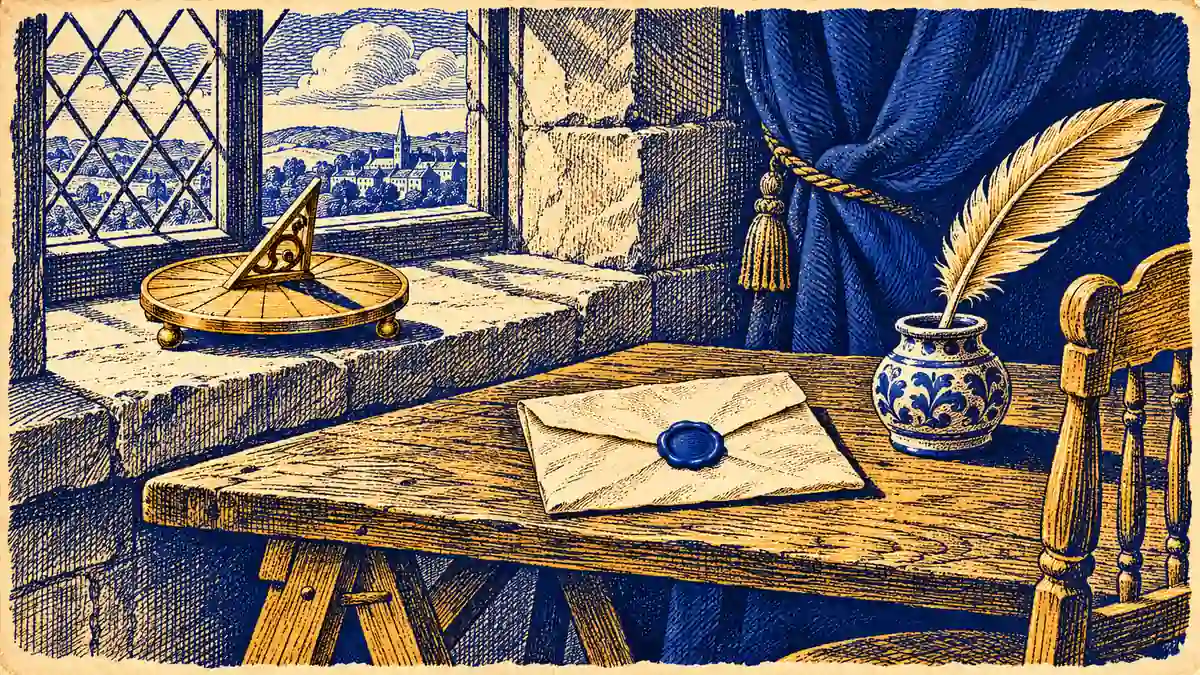
An explanatory pause can stop a historical scene just as it begins to move. In these two versions, notice how much attention the first gives to background information while Eleanor is trying to finish a letter:
Before: Eleanor sat at the heavy walnut trestle table to write the letter to her brother in Norwich. The oak ink she dipped her goose quill into was made from crushed oak galls mixed with ferrous sulfate, which produced a rich dark ink that had been popular among English clerks since the fourteenth century. The rag paper beneath her hand was imported from Genoa at great expense, because English paper mills would not become widespread until the seventeenth century, making every single sheet precious to a merchant family. She checked the bronze sundial on the windowsill, knowing the carrier wagon departed the coaching inn on Bishopsgate at four in the afternoon on Tuesdays, giving her only half an hour to finish the dispatch regarding the wool shipment.
After: Eleanor sat at the trestle table to write the letter to her brother in Norwich. She dipped her quill into the inkpot and smoothed the precious imported paper beneath her hand. The shadow on the bronze windowsill sundial showed half an hour before four, leaving her barely enough time to finish the dispatch before the carrier wagon rolled out from Bishopsgate.
The After version cuts the ink chemistry and the background on Continental paper manufacturing and trade. Those facts did not affect Eleanor's immediate task. The paper, quill, and deadline on the sundial remain, giving the reader enough period detail to follow her actions. The passage moves faster because it keeps attention on whether she can finish and send the letter in time.
Four common mistakes to avoid in historical fiction
Check your scenes for these four problems when you revise:
The encyclopedia parade
It is tempting to use every detail you worked hard to find. But knowing a city's paving material and street-cleaning costs does not mean you need to describe them while your protagonist flees a pursuer. Let the research inform your account of the place, then choose the details that belong in the character's immediate experience. You can know considerably more than you put on the page.

The modern moralizer
A protagonist can question their society and still belong to their period. Trouble starts when the writer gives them twenty-first-century social, political, and philosophical views without accounting for that distance. A medieval blacksmith who champions modern democratic egalitarianism, or an eighteenth-century aristocrat who speaks like a contemporary therapist, can break the reader's belief in the setting. Consider the prejudices, spiritual anxieties, and social assumptions the character has grown up with, including those they struggle against.
The gadzookery trap
Archaic dialogue tags, obsolete pronouns, and filler words such as thee, thou, hark, prithee, and forsooth can turn a serious exchange into pantomime. Sentence rhythm, social distance, and period concerns do more to establish the setting. Use standard English syntax with nouns and verbs appropriate to the period, and check for modern slang. The reader should be able to follow what the speakers want without stopping to admire their antique vocabulary.
The passive bystander protagonist
A fictional protagonist needs a personal reason to take part in historical events. If they wander from one famous person's speech to another, the story gives them little to do. Securing a lease, escaping an arranged marriage, or avenging a family debt gives the character something urgent to pursue. Let that struggle drive the plot, with public events making the goal harder to reach. The character's involvement should matter beyond giving the reader a view of history.
Frequently asked questions
How much can an author alter real historical facts and timelines?
Novelists can compress timelines, combine minor figures into composite characters, and invent private dialogue when those choices serve the story. Well-documented public outcomes need different treatment. Having the wrong faction win a major battle, for example, calls for labeling the work as alternative history. If you adjust minor historical sequences for pacing, explain those decisions in an author's note at the end of the book.
Should I finish all my research before I begin drafting?
Research can always lead to another question, so waiting to finish it can prevent you from drafting at all. Learn enough about the physical setting, major legal constraints, and daily routines to begin writing scenes. When you reach an unknown detail, such as a carriage fare or the fastener on a cloak, leave a bracketed placeholder and keep going. Return to those specific questions during revision, when you can check the facts without interrupting the draft.